

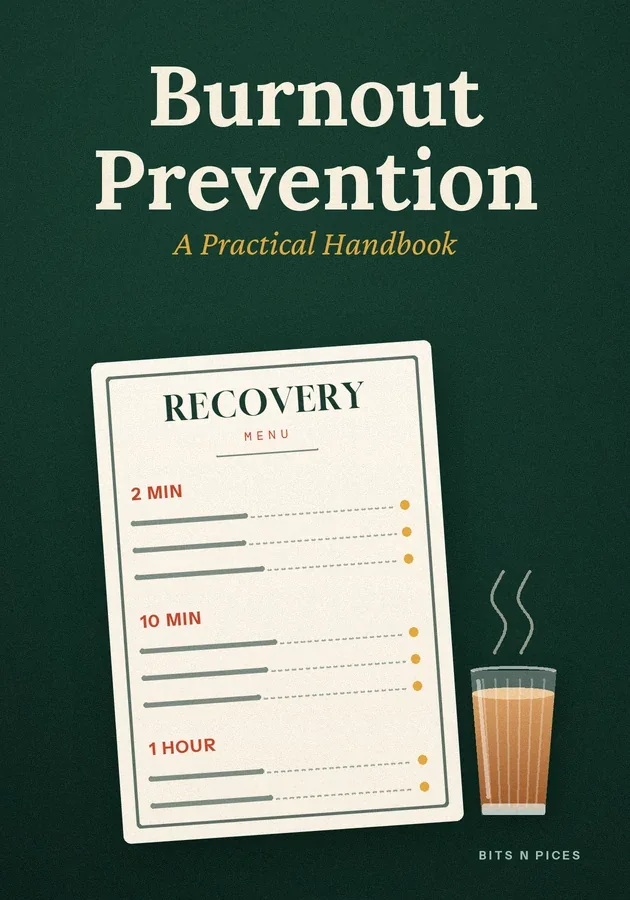
Burnout Prevention: A Practical Handbook
Key takeaways
- Write down every task your household runs on, including the invisible planning, then agree who owns each one rather than who helps.
- Spend twenty minutes each Sunday matching the week's heaviest days to your energy, and drop, move or share one thing on each.
- Keep a written recovery menu of two-minute, ten-minute and one-hour options so that real rest is quick to choose when you are tired.
- Use short, prepared scripts to decline, delay, delegate and ask for help, because a tired brain struggles to find the words on the spot.
- Children learn rest by watching you, so name your tiredness calmly, show how you recover and keep adult worries off their shoulders.
Inside this bit
- Step one: the household load audit
Burnout in parents often starts with a load nobody has measured. Before changing anything, take ten minutes and a sheet of paper.
- The Sunday reset and the morning traffic light
Two short routines keep the load visible. The Sunday reset takes twenty minutes.
- Build a recovery menu before you need it
When you are exhausted, choosing how to rest is surprisingly hard, and the phone usually wins by default. A recovery menu solves this.
- Scripts for saying no and asking for help
Tired brains struggle to find the right words, so prepare them in advance. Four scripts cover most situations.
- Showing your children how to rest
Children learn more from what they see than from what they are told. If they only ever watch you rushing, they learn that grown-ups never stop.
- Your warning-sign checklist and family plan
Agree in advance what you will do when the signs appear, because decisions made in the middle of exhaustion are usually poor ones. Write a short checklist of your own early warnings.
Learn it six ways
Visualize, Mind Map, Practice, Scenario, Challenge and Review are written for this book.
Quiz and flashcards
Test what you read and keep it with spaced repetition.
Bits AI
It answers about the book, the section, the quiz question you are on.





