

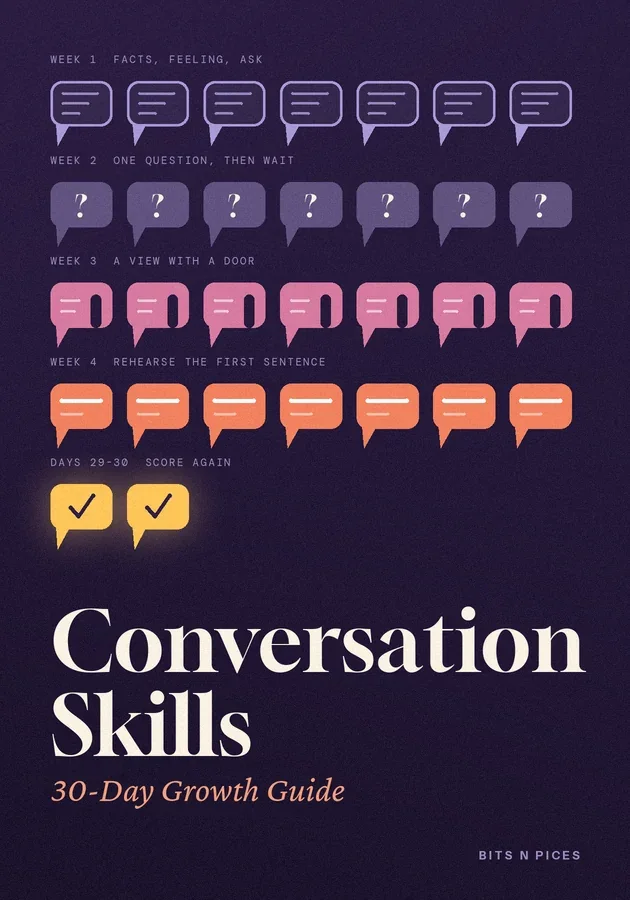
Conversation Skills: 30-Day Growth Guide
Key takeaways
- Listen for three layers in every message, the facts, the feeling and the ask, and name feelings tentatively so a wrong guess is easy to correct.
- Ask one question at a time, pin down vague words with a clarifying question, and wait a slow count of four before filling any silence.
- Offer opinions as a view with a door, what you think, one reason and what am I missing, using words that match how sure you are.
- Before a conversation you have been avoiding, rehearse only your first sentence, and when criticised ask for one example and find the part that is true.
- Score three conversations before day one and again on day twenty-nine, and when a week slips, resume with the smallest version instead of restarting.
Inside this bit
- The shape of the month and your baseline
This programme runs for four weeks with one theme each: attention, then questions, then opinions and stories, then the hard conversations most people avoid. Every day brings one micro-action, a small deliberate move of five to fifteen minutes built into conversations you would have anyway.
- Week one: listening for three layers
Week one trains attention. Every message carries three layers: the facts, meaning what happened; the feeling, meaning how the person feels about it; and the ask, meaning what they want from you, whether advice, help or simply a hearing.
- Week two: questions that open rather than close
Week two replaces reflex questions with ones that open a conversation. Three moves carry the week.
- Week three: opinions and stories that land
Many people listen and ask well, then vanish when it is their turn to say something. Week three trains the other half: offering opinions and short stories.
- Week four: the conversations you usually avoid
The final week takes on the conversations people postpone for months. Three kinds recur.
- Keeping score and rescuing a lost week
Measure three things. A daily tick shows whether you did the micro-action at all.
Learn it six ways
Visualize, Mind Map, Practice, Scenario, Challenge and Review are written for this book.
Quiz and flashcards
Test what you read and keep it with spaced repetition.
Bits AI
It answers about the book, the section, the quiz question you are on.





