

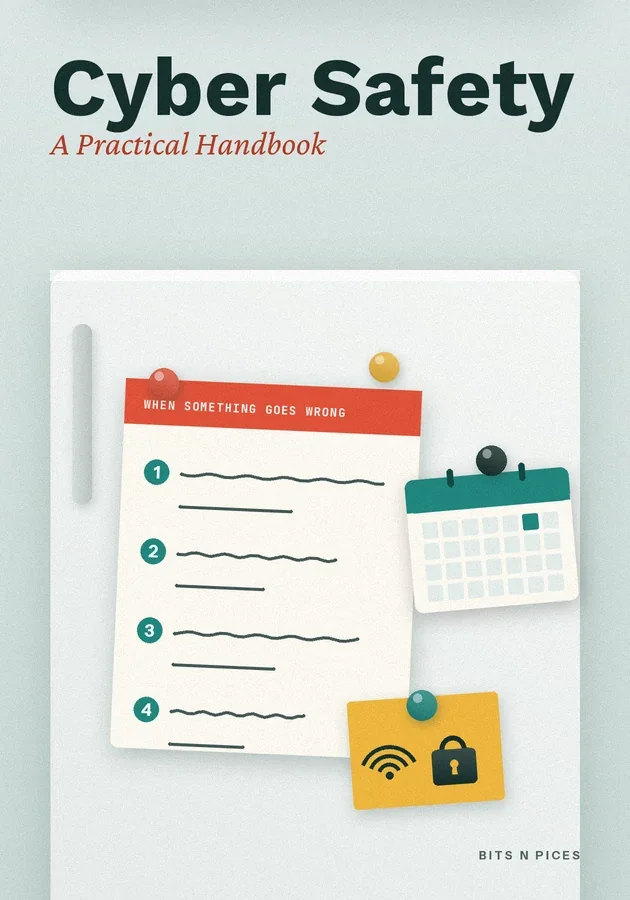
Cyber Safety: A Practical Handbook
Key takeaways
- Run a fifteen-minute device audit once a month, checking every screen in the house for updates, screen locks and apps nobody uses any more.
- Before handing a child a new phone or tablet, set it up with a child account, app approval and privacy settings already switched on.
- A family password manager keeps Wi-Fi, streaming and school logins in one shared place, so nobody writes passwords on sticky notes again.
- Change your router's admin password, check it uses WPA2 or WPA3, and put visitors and smart gadgets on a separate guest network.
- A written family agreement plus a weekly five-minute check-in teaches children to tell you early, which protects them more than any filter.
Inside this bit
- The monthly device audit, step by step
Pick a fixed evening, such as the first Sunday of the month, and give it fifteen minutes. Gather every device that connects to the internet: phones, tablets, laptops, the gaming console, the smart TV, even the old phone a child uses as a music player.
- Setting up a child's first device
Do the setup yourself before the box is opened in front of your child, so the safe version is the only version they ever see. Most phones, tablets and consoles now include free family controls built into the system, so start there before looking at extra apps.
- A family password system that works
Sticky notes on the fridge and one shared password for everything are how most families start, and both leave the whole household exposed if one site leaks. A password manager fixes this.
- Securing the home Wi-Fi in twenty minutes
The router, the small box with blinking lights, is the front door to every device in the house, and many families have never changed the password printed on its sticker. Here is a routine for any weekday evening.
- The family agreement and weekly check-in
Settings catch some problems; conversation catches the rest. Write a one-page family tech agreement together, in your children's words where possible.
- When something goes wrong: the fridge card
In a crisis nobody remembers a long list, so write a short one and stick it on the fridge. A good incident card has four headings.
Learn it six ways
Visualize, Mind Map, Practice, Scenario, Challenge and Review are written for this book.
Quiz and flashcards
Test what you read and keep it with spaced repetition.
Bits AI
It answers about the book, the section, the quiz question you are on.





