

Data: 30-Day Growth Guide
Key takeaways
- Ten to fifteen minutes a day for four weeks is enough to collect, organise, summarise and explain a small dataset of your own.
- Write a one-line definition of what you are measuring before day one, so every entry in your record means exactly the same thing.
- Keep one row per day and one kind of value per column, with the unit in the header, and your data stays easy to count.
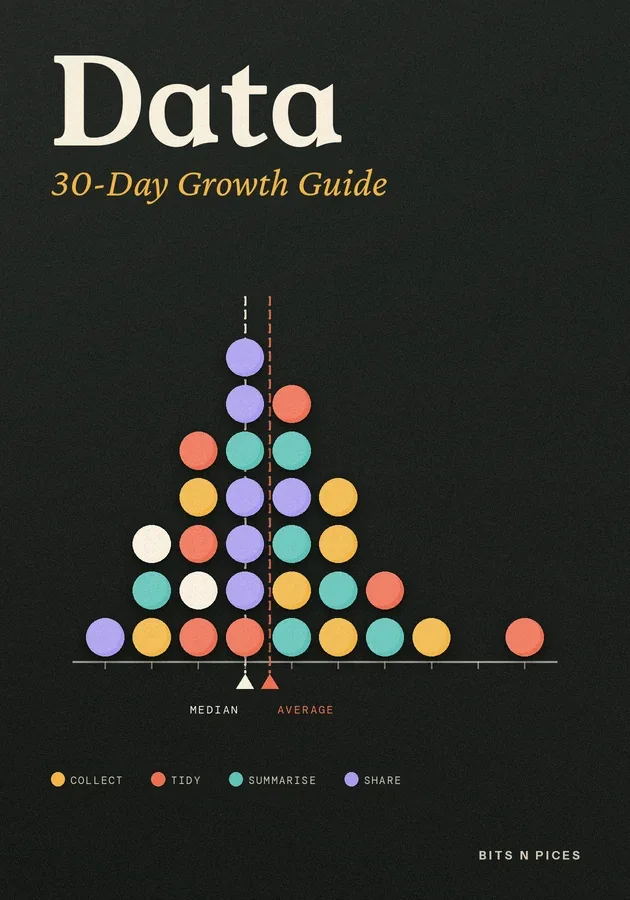
- Report the median beside the average whenever one unusual day could pull the average away from what a typical day looks like.
- When a week slips, leave the missing days blank, shrink the daily task to five minutes and carry on rather than starting again.
Inside this bit
- What thirty days of data practice builds
Data is simply information recorded so it can be counted or compared: the minutes a bus took, the number of customers before lunch, the price of onions each week. A dataset is a collection of those records about the same thing.
- Week one: collect a small dataset of your own
Choose something you can measure every day without special equipment. Good choices are how long your journey to work takes, how many messages arrive before noon, or how long the queue is at the ration shop.
- Week two: give your data a tidy home
A spreadsheet is a grid for storing data. Each horizontal line is a row, each vertical line is a column, and each box where they meet is a cell.
- Week three: summarise and draw one chart
A summary squeezes many numbers into a few that describe them. The count is how many observations you have.
- Week four: ask one question and share it
Now your data can answer a question. Keep it small and specific: are journeys longer on Mondays than on other days, or is the early bus quicker than the later one?
- Measuring progress and rescuing a slipped week
Progress in this programme is measured in skills, not streaks. At the end of each week, ask yourself one question and answer yes or no.
Learn it six ways
Visualize, Mind Map, Practice, Scenario, Challenge and Review are written for this book.
Quiz and flashcards
Test what you read and keep it with spaced repetition.
Bits AI
It answers about the book, the section, the quiz question you are on.





