

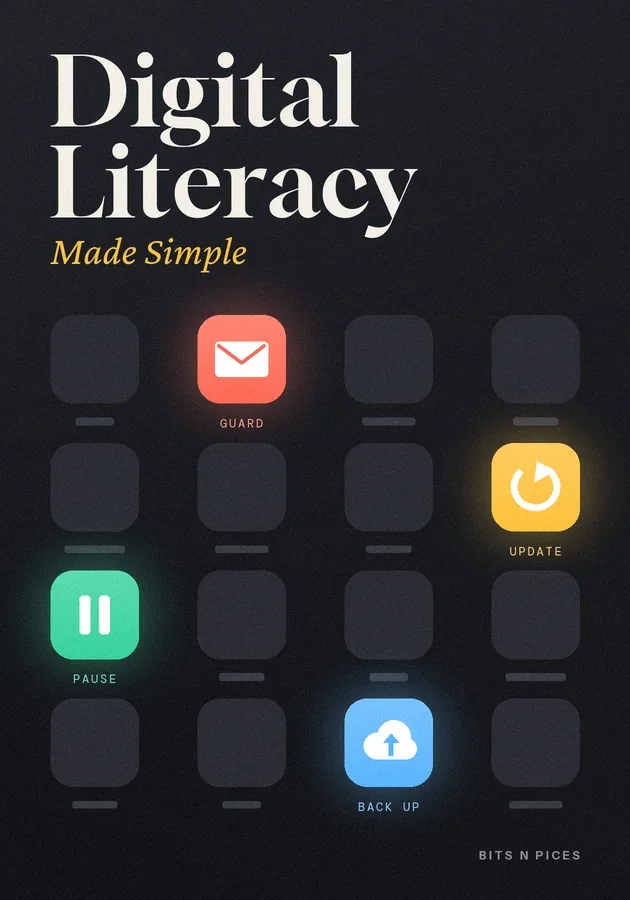
Digital Literacy Made Simple
Key takeaways
- Four habits do most of the work: guard your email and phone number, keep things updated, pause before tapping or sharing, and back up what matters.
- Private browsing hides history on your own device only; your school, office, internet provider and the sites you visit can still see what you do.
- Feeds show your child whatever keeps them watching, not what is true or good, so ask together why a particular video was recommended.
- Every family post adds to a trail that can reveal a child's full name, school and birthday, so check each photo for what it gives away.
- Voices and videos can now be faked convincingly, so agree a family code word and confirm any urgent money request through a second channel.
Inside this bit
- The few habits that do most of the work
If digital life feels like a thousand things to learn, start here, because four habits cover most of the risk. Think of your family's online life as a house.
- Myths that keep families exposed
A handful of comfortable beliefs cause a lot of trouble. Private or incognito browsing only stops your own device from keeping a history; the school network, your employer, your internet provider and every site you visit can still see the activity.
- How feeds decide what your child sees
A feed is not a list of what is new or true. It is a system that watches what each person pauses on, replays, likes and shares, then serves more of whatever kept them watching.
- Your family's data trail, in plain words
Every post, photo, search and location check-in leaves a footprint, and online footprints are made in wet cement rather than sand. On their own they look harmless.
- Fakes that look real: voices, videos and pressure
Tools that can imitate a voice from a short clip, or put one face onto another person's video, are now cheap. That breaks an old rule.
- Teaching it at home without a lecture
Children learn digital judgement mostly by watching what adults do, so let them see your thinking. When a strange message arrives, narrate the check aloud: this link does not match the company, so I will open the app myself.
Learn it six ways
Visualize, Mind Map, Practice, Scenario, Challenge and Review are written for this book.
Quiz and flashcards
Test what you read and keep it with spaced repetition.
Bits AI
It answers about the book, the section, the quiz question you are on.





