

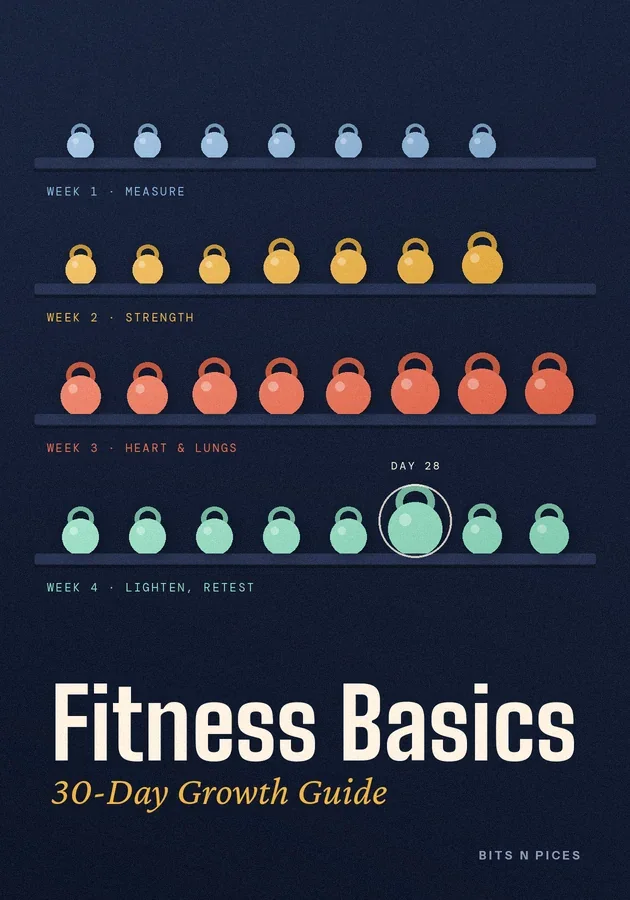
Fitness Basics: 30-Day Growth Guide
Key takeaways
- Spend the first week measuring rather than straining: a chair-stand test, a push-up test and a timed walking route give you a baseline worth beating.
- Build strength with double progression: stay at one difficulty until every set reaches the top of your rep range cleanly, then make the exercise harder.
- Keep most cardio easy enough to talk through and limit hard sessions to one or two a week, because stacked hard days drain recovery and stall progress.
- Retest on day twenty-eight under the same conditions as day one, then choose next month's single focus from whichever result moved least.
- When a week slips, repeat it rather than skipping ahead, never cram missed sessions into fewer days, and restart a week earlier after illness.
Inside this bit
- How the four weeks fit together
This programme assumes you already move a little and know what a squat or a push-up is. Its job is to turn scattered effort into a month with a shape.
- Week one: measure before you push
Week one is for measuring and settling a rhythm, not for heroics. Pick three tests and record them carefully.
- Week two: strength with a progression rule
Week two brings three short full-body strength sessions, spaced so that no muscle group works hard two days running. Each session covers a squat, a hinge, a push, a pull and a carry or plank.
- Week three: training heart and lungs wisely
Week three adds conditioning, meaning work that trains the heart and lungs. Use three effort levels from the talk test: easy means you can speak in full sentences, moderate means short phrases, and hard means only a few words at a time.
- Week four: lighten, retest and plan
Fatigue hides fitness, so the first half of week four is lighter: the same sessions with fewer sets and no hard intervals. On day twenty-eight, repeat the week-one tests under identical conditions and lay the two sets of numbers side by side.
- When a week slips, and when to stop
Almost every thirty-day plan meets a lost week, so decide the rules now. If you miss a day or two, carry on from where you are.
Learn it six ways
Visualize, Mind Map, Practice, Scenario, Challenge and Review are written for this book.
Quiz and flashcards
Test what you read and keep it with spaced repetition.
Bits AI
It answers about the book, the section, the quiz question you are on.





