

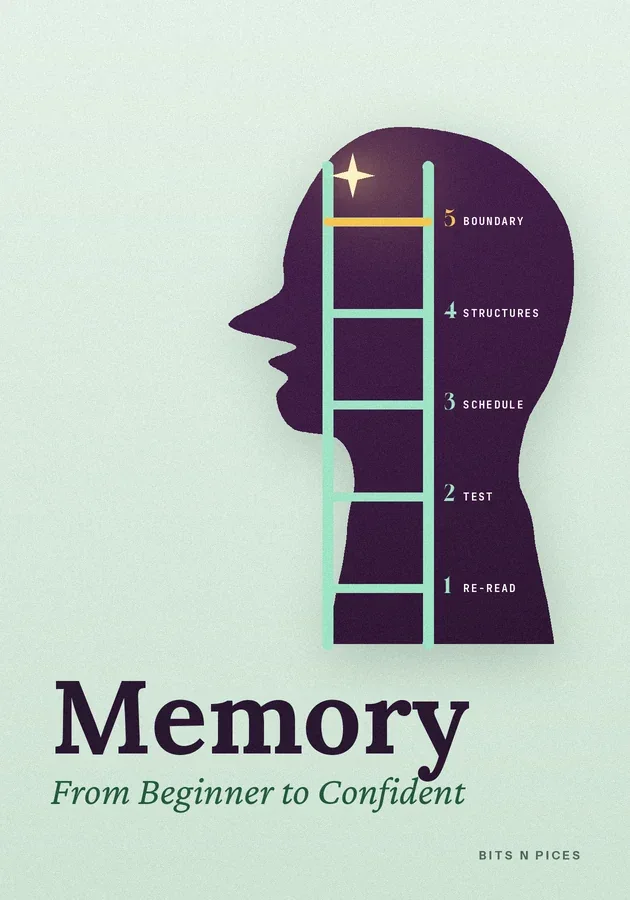
Memory: From Beginner to Confident
Key takeaways
- Run a cold-start test on something you learned a month ago; what survives with no warning shows your real rung better than any study session.
- Predict your score before every self-test and compare afterwards, because honest calibration tells you which knowledge to trust and where to spend your time.
- Cap how many new items you add each day, since every addition books months of reviews and unmanaged review debt quietly kills good habits.
- Organise facts around a few principles and save mnemonics for arbitrary material, because frameworks scale where hundreds of vivid images start to blur.
- Decide deliberately what belongs in your head, the knowledge you need fast or think with, and keep everything else in a reliable, well-sourced reference.
Inside this bit
- Five rungs from hoping to designing
Confidence with memory is a skill that climbs in stages, and each stage has a different main tool. On rung one, hoping, you re-read, highlight and trust that familiar pages mean knowledge.
- Rung one to two: from re-reading to testing
The jump from rung one to rung two is mostly a change in the order of work. On rung one you read, then perhaps test.
- Rung three: running a review schedule
Rung three turns good testing into a schedule. Items you recall easily wait longer before their next review; items you miss come back soon, so the gaps grow as each memory strengthens.
- Rung four: building structures that hold
At rung four you stop memorising facts one at a time and start building frameworks for them. A schema is a mental structure that organises many facts around a few principles.
- Rung five: deciding what belongs in your head
Designing means treating memory as one part of a larger system. Not everything deserves a place in your head.
- Deliberate practice, plateaus and proof you climbed
Deliberate practice here means working at the edge of what you can recall, with feedback, rather than repeating what already comes easily. Keep a short weekly log with three measures: how much of last month's material you recall cold, how close your predictions were to your scores, and whether you could use the knowledge on a case you had not seen before.
Learn it six ways
Visualize, Mind Map, Practice, Scenario, Challenge and Review are written for this book.
Quiz and flashcards
Test what you read and keep it with spaced repetition.
Bits AI
It answers about the book, the section, the quiz question you are on.





