

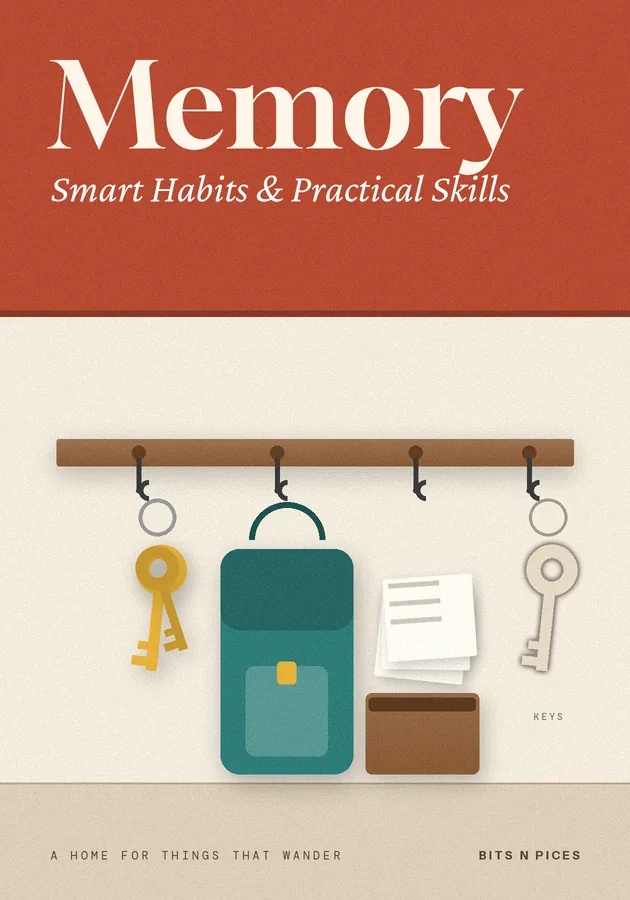
Memory: Smart Habits & Practical Skills
Key takeaways
- Most family forgetting is a system problem, so give keys, bags and permission slips a fixed home before blaming anyone's memory.
- Tie each new memory habit to something your family already does daily, such as brushing teeth or clearing the dinner table.
- Make the right action easy and the distracting one awkward: spelling cards by the kettle, phones charging outside the homework room.
- Help children remember what they study by asking them to recall and explain it, a little at a time across the week.
- When routines collapse during holidays or exams, restart with the smallest version and let your children see you using the habits too.
Inside this bit
- Why busy households forget
Every family has a forgetting pattern: the swimming kit left on the bed, the form that needed signing yesterday, the phone charger at a relative's house. It is tempting to call this a bad memory, but most of it is a system problem.
- A home for things that wander
The single most useful memory habit for a family costs nothing: every item that travels in and out of the house gets one fixed home. Keys hang on one hook.
- Cues that do the remembering for you
A cue is anything that triggers an action without you having to think of it. The strongest cues come from routines your family already has.
- Friction: making the right thing easy
Friction is the small effort that stands between you and an action. Habits grow where friction is low and wither where it is high, and you can use that on purpose.
- Helping children study so it sticks
Children, like adults, often study by rereading notes until they look familiar, which feels productive but fades quickly. Two habits work better, and both fit around family life.
- Tracking, resets and keeping it going
A family habit needs a light way of noticing whether it is working. A simple chart on the fridge with a tick for each morning the launch pad did its job is enough.
Learn it six ways
Visualize, Mind Map, Practice, Scenario, Challenge and Review are written for this book.
Quiz and flashcards
Test what you read and keep it with spaced repetition.
Bits AI
It answers about the book, the section, the quiz question you are on.





