

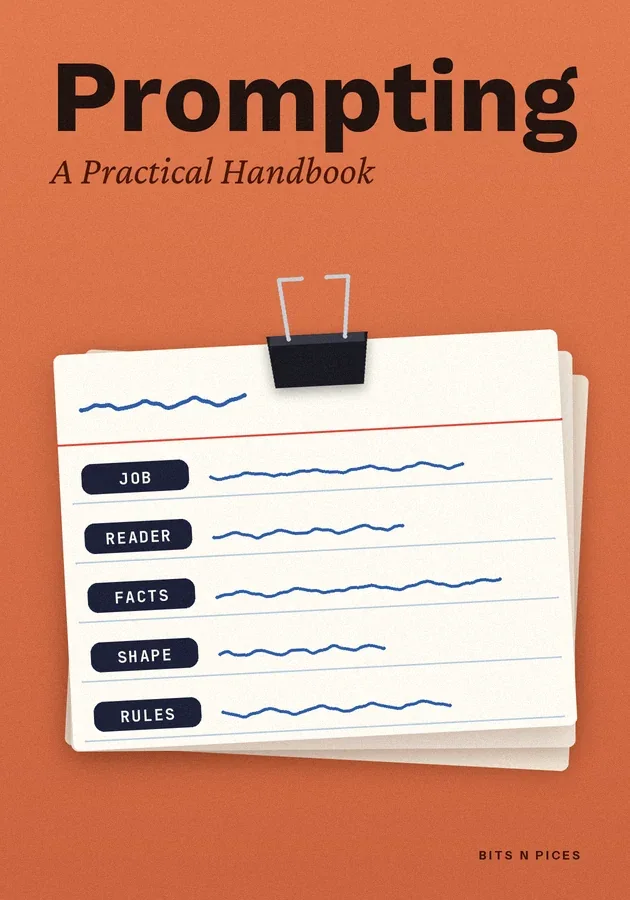
Prompting: A Practical Handbook
Key takeaways
- Use the same five-line card for every household prompt: job, reader, facts, shape and rules, and stop composing from scratch each time.
- Set the tool up as a tutor with a fixed opening instruction so it asks your child questions instead of handing over answers.
- Run the four-point check on every output before it leaves the house: facts, names and numbers, tone, and anything private that slipped in.
- Write the family AI rules on one card, stick it by the screen, and revisit it with the children each school term.
- Ten minutes on Sunday to prune and improve your saved prompts keeps the household library sharp and the whole system running.
Inside this bit
- The five-line card you will use every time
A handbook needs one procedure that covers most days, and this is it. Every prompt you write for the household goes on five lines.
- Procedure: setting up a tutor, not an answer machine
Children default to asking for answers, so the setup has to make questions the easier path. The procedure has three steps.
- Procedure: the weekly household batch
Certain jobs repeat every week and suit one sitting. Meal planning, the school-week schedule, the reply to a school circular, a message to a relative, and a plan for Sunday all fit.
- Checklist: before any output leaves the house
Every reply gets the same four-point check, and it takes under a minute. One: facts.
- Template: the family rules card
Children follow rules they helped write and can see. The template has five lines and fits on an index card by the screen.
- Upkeep: ten minutes on Sunday
A library of prompts decays if nobody tends it. The upkeep procedure is short.
Learn it six ways
Visualize, Mind Map, Practice, Scenario, Challenge and Review are written for this book.
Quiz and flashcards
Test what you read and keep it with spaced repetition.
Bits AI
It answers about the book, the section, the quiz question you are on.





