

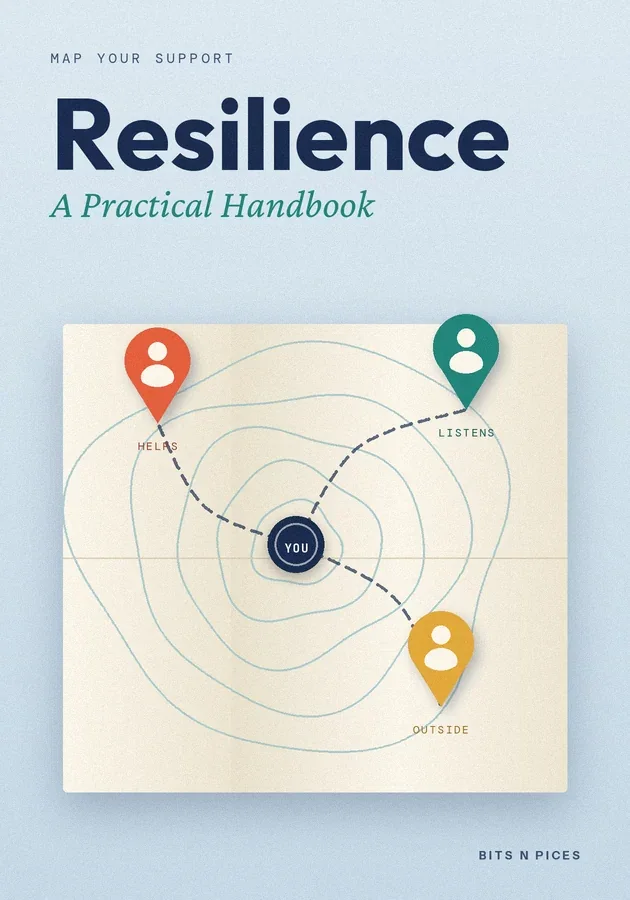
Resilience: A Practical Handbook
Key takeaways
- Run a four-question debrief after a setback once feelings have cooled: what happened, what was in our control, what we learned, what comes next.
- A fifteen-minute weekly family check-in, with a no-fixing rule unless someone asks, builds the habit of talking about hard things early.
- Ask your child whether they want help or just want you to listen before offering solutions, and repair quickly when you get it wrong.
- Draw a support map for yourself and each child, naming who helps practically, who listens and which trusted adults sit outside the family.
- In heavy weeks, cut down to a short list of basics and drop or delay the rest, because lowering standards for a while is a strategy.
Inside this bit
- The four-question setback debrief
A debrief turns a painful event into something your family can learn from, and it works for adults and children alike. Use four questions: What happened?
- A fifteen-minute weekly family check-in
Resilient families talk about difficulty before it becomes a crisis, and a weekly check-in makes that routine. Attach it to a time that already exists, such as Sunday dinner or a Saturday drive, and keep it to fifteen minutes.
- Scripts for the hard moments
Hard moments move fast, so it helps to have words ready. When a child comes home upset, the most useful first line is often a question: 'Do you want help with this, or do you want me to just listen?
- Drawing a support map
Resilience leans heavily on other people, yet most parents have never looked at their support network on paper. A support map takes ten minutes.
- The heavy-week checklist
Some weeks will not bend: a relative in hospital, a crisis at work, exams, a house move. A parent's resilience in those weeks depends less on willpower and more on what you stop doing.
- Struggle or step in: making the call
Children build resilience by meeting difficulty they can manage with some support. If adults remove every obstacle, children miss the practice; if adults step too far back, children can feel alone.
Learn it six ways
Visualize, Mind Map, Practice, Scenario, Challenge and Review are written for this book.
Quiz and flashcards
Test what you read and keep it with spaced repetition.
Bits AI
It answers about the book, the section, the quiz question you are on.





