

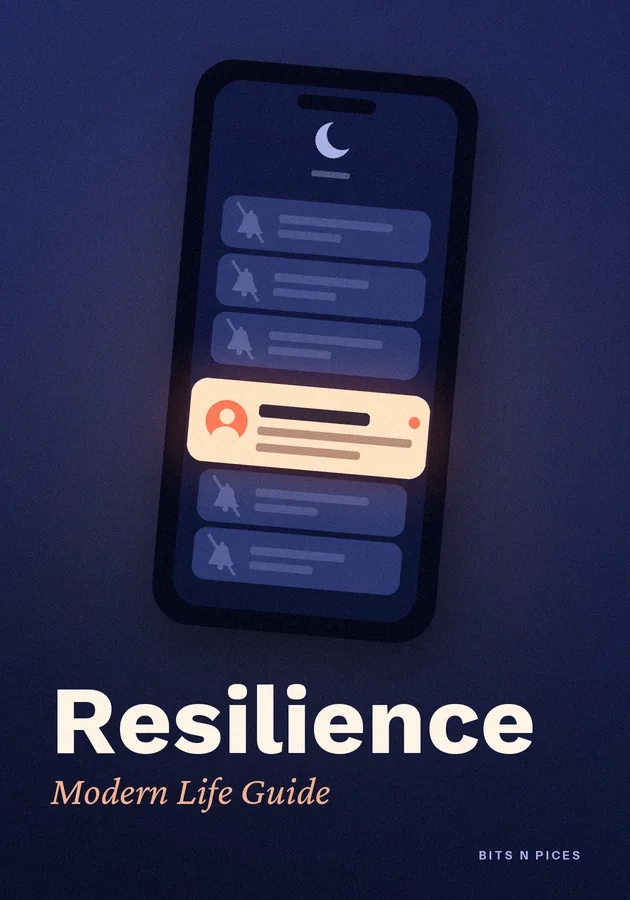
Resilience: Modern Life Guide
Key takeaways
- Your stress response is ancient, but modern life removed its natural stopping points, so recovery now has to be scheduled rather than left to chance.
- Treat every notification as a tiny alarm and decide which ones may interrupt you, while keeping open the channels your support network actually uses.
- When work has no commute and no finish line, a five-minute shutdown ritual gives your mind the ending the office door once provided.
- Before consuming distressing news or comparison-heavy feeds, ask what you can actually do with it; information without agency drains rather than prepares you.
- Resilience is not endless endurance: sometimes the resilient move is to change the situation, renegotiate expectations or ask for help rather than cope harder.
Inside this bit
- What changed about pressure, and what held
The body's stress response has not changed in thousands of years. A threat, real or imagined, raises your heart rate, sharpens attention and readies you to act.
- Your phone as stress amplifier and lifeline
Each notification is a small alarm. Your brain has to decide, even for a moment, whether it matters, and dozens of those decisions a day keep the stress system slightly switched on.
- Remote work without a finish line
Working from home removed the commute and, with it, the buffer that let people leave work behind. Many remote and hybrid workers now shut their laptops at nine at night simply because nothing tells them to stop.
- Information overload and the endless news cycle
Feeds are built to hold attention, and alarming content holds it best. The result is a pattern many people recognise: an hour of distressing stories about events they cannot influence, followed by a vague dread and no action.
- Money pressure and comparison culture
Financial worry is one of the most common sources of long-running stress, and modern life adds layers to it. Instant credit makes spending frictionless, subscriptions renew quietly, and feeds serve a curated stream of holidays, weddings and new phones that makes an ordinary life feel like falling behind.
- Recovery by design, and knowing when to change
In an always-on world, recovery does not happen by itself; it has to be designed. Protect a few non-negotiables: a consistent sleep window, some movement each day, one screen-free hour and regular time with people who know you well.
Learn it six ways
Visualize, Mind Map, Practice, Scenario, Challenge and Review are written for this book.
Quiz and flashcards
Test what you read and keep it with spaced repetition.
Bits AI
It answers about the book, the section, the quiz question you are on.





