

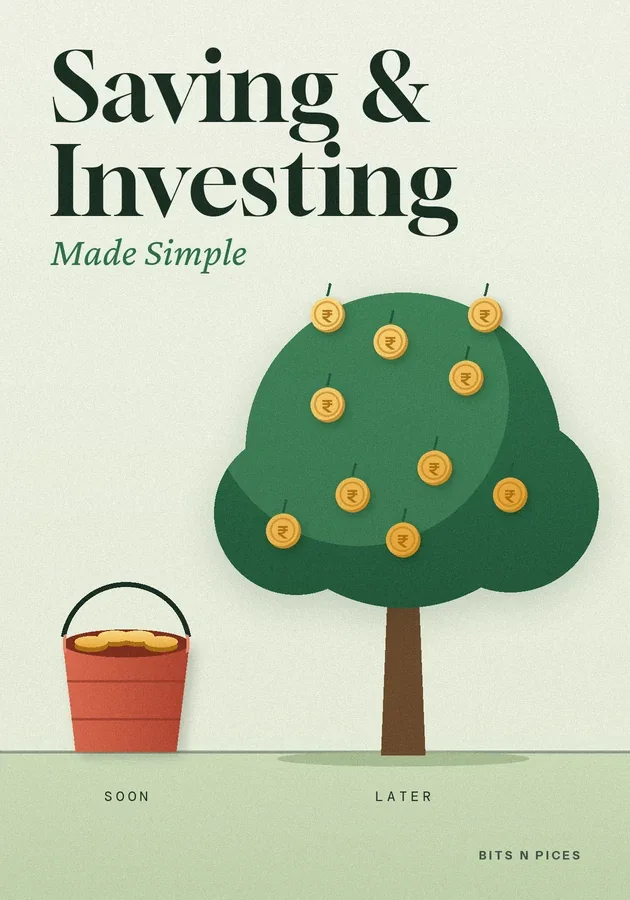
Saving & Investing Made Simple
Key takeaways
- Saving is a bucket for money you will need soon; investing is a tree for money you can leave alone for many years.
- Compound growth rewards time more than size, so a small amount started early can outgrow a larger amount started years later.
- Pay yourself first with an automatic transfer on payday, because saving whatever is left at the end of the month rarely leaves anything.
- Any offer promising both safety and very high returns is a warning sign, because higher returns always come with higher risk.
- A short monthly family money chat and three simple jars teach children more about money than any lecture you could give.
Inside this bit
- It is simpler than it looks
If money talk makes you want to change the subject, you are in good company. Much of the confusion is noise: new products, clever names, urgent headlines.
- A bucket for soon, a tree for later
Saving and investing sound alike but do different jobs. Saving is a bucket: you fill it with water you will need soon, and you want it exactly where you left it.
- The snowball that does the heavy lifting
Compound growth is the most useful idea in this book, and it fits in one sentence: money earns a little, and then that little earns too. Picture a snowball rolling downhill.
- Five myths that keep families stuck
Myth one: you need a lot of money to start. Small regular amounts, started early, matter more than a lump sum you are still waiting for.
- The few moves that do most of the work
If you remember nothing else, remember four moves. First, pay yourself first: set an automatic transfer on payday, even a small one, so saving happens before spending can reach it.
- Bringing the whole family along
Children learn money more from routines than from lectures. A monthly fifteen-minute family money chat works well: one thing that went well, one surprise and one choice for next month.
Learn it six ways
Visualize, Mind Map, Practice, Scenario, Challenge and Review are written for this book.
Quiz and flashcards
Test what you read and keep it with spaced repetition.
Bits AI
It answers about the book, the section, the quiz question you are on.





