

The Essential Guide to Information Evaluation
Key takeaways
- Every claim can be weighed with five questions: who says so, how do they know, what is missing, does the conclusion follow, and why do I want it?
- Trust a source for what it knows rather than who it is: expertise must match the claim, and an incentive means the claim needs stronger support.
- Evidence comes in grades, from a single story to many independent studies agreeing, and surprising or costly claims need support from the stronger end.
- Many misleading claims are built from true facts, so check the time window, the total, the comparison and the full quote before you judge.
- Spend checking effort where the stakes are high, discount surface polish, and treat 'not yet known' as a respectable answer rather than a failure.
Inside this bit
- The map: five questions and a dial
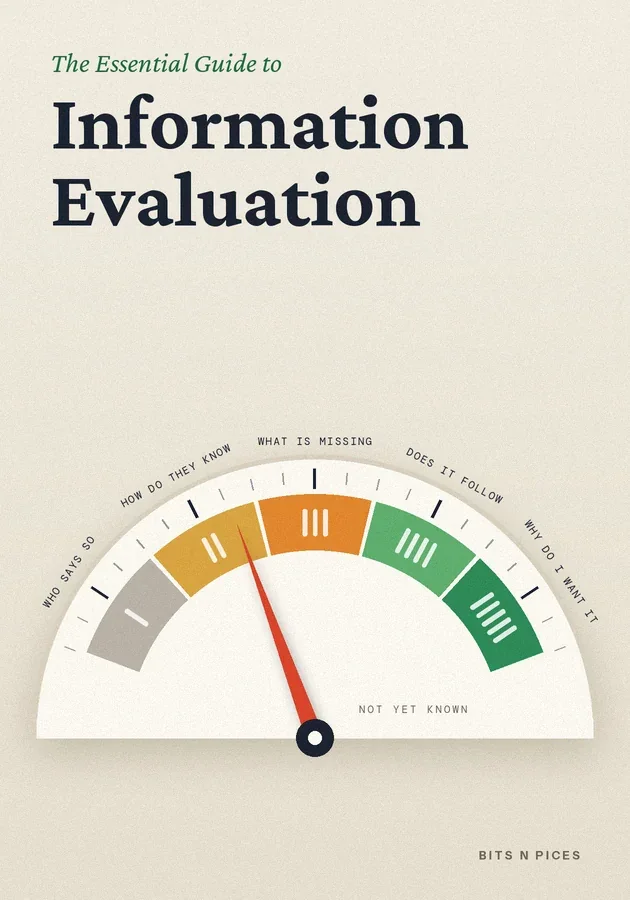
Information evaluation can feel like a heap of unrelated tips. It becomes manageable once you see that nearly every tip answers one of five questions.
- Source: expertise, incentives and accountability
Judging a source means asking three separate things. Expertise: does this person or organisation have specific knowledge of this particular question?
- Evidence: grades, not yes or no
Evidence is rarely simply present or absent; it comes in grades. At the weak end sits a single story: my cousin tried it and it worked.
- Context: when true facts mislead
Many misleading claims contain no false facts at all. They mislead through what is left out, and five patterns cover most of them.
- Reasoning, and the person doing it
Even true, well-sourced facts can be joined by faulty reasoning. The most common leap is from correlation to cause: towns with more libraries have more graduates, but both may simply follow income.
- What to prioritise and what to ignore
Nobody can check everything, so the essential skill is allocation. Prioritise claims that will change a decision, move money, affect health or safety, or that you are about to pass on.
Learn it six ways
Visualize, Mind Map, Practice, Scenario, Challenge and Review are written for this book.
Quiz and flashcards
Test what you read and keep it with spaced repetition.
Bits AI
It answers about the book, the section, the quiz question you are on.





