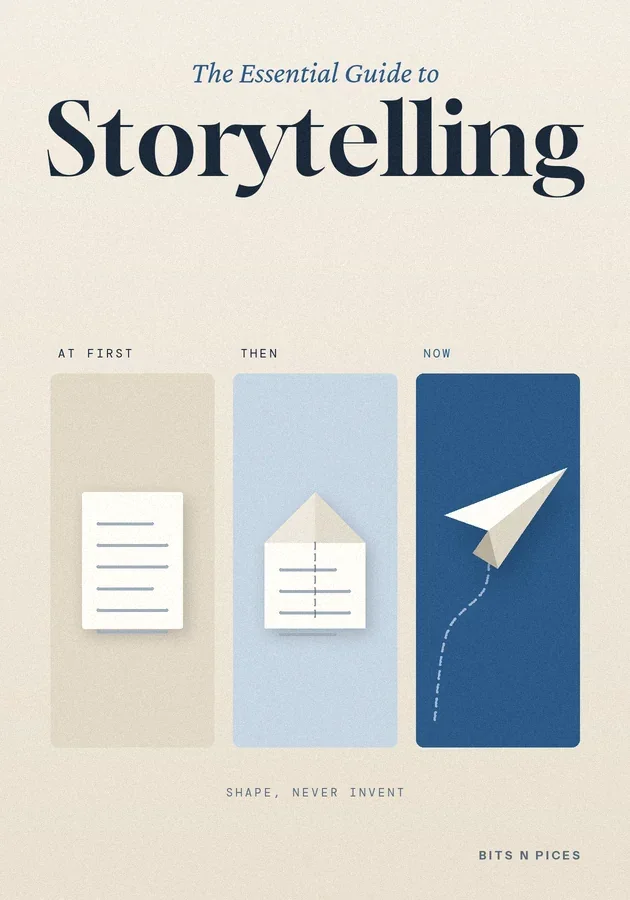
The Essential Guide to Storytelling
Key takeaways
- A story needs a change the listener can feel, so test every draft with at first, then, and now before you tell it.
- Write your point as one sentence before you speak, then keep only the moments and details that serve that sentence.
- Open inside a specific moment, build tension with one obstacle, let the turn happen and land on what the change meant.
- Spend your strongest concrete detail at the turn, and let the listener decide the length, the background and the rest of the detail.
- Shape freely but never invent: choose the start, compress time and cut dull parts, yet keep every fact, number and quote true.
Inside this bit
- What a story is, and what it is not
A story is an account of someone who wants something, meets a difficulty and ends up changed. That last part matters most.
- Idea one: change is the engine
If nothing changes, you have described a situation, not told a story. The change can be large, such as a job lost or a city left, or tiny, such as a mind changed about a neighbour.
- Idea two: know your point before you start
The point is the one idea you want the listener to carry away. Tellers who skip it wander, because without a destination every detail seems worth including.
- Idea three: the shape that holds attention
Most short stories that work share a four-part shape. The opening drops the listener into a specific moment rather than into background.
- Ideas four and five: detail and the listener
A single concrete detail does more than a string of adjectives. Saying the office was chaotic gives the listener your opinion; saying three phones rang while the printer chewed the only copy of the contract lets them see it and reach the opinion themselves.
- Idea six, the trade-offs and what to ignore
The sixth idea is trust. You may shape a story: choose where it starts, compress three weeks into a sentence, leave out the dull stretches.
Learn it six ways
Visualize, Mind Map, Practice, Scenario, Challenge and Review are written for this book.
Quiz and flashcards
Test what you read and keep it with spaced repetition.
Bits AI
It answers about the book, the section, the quiz question you are on.