

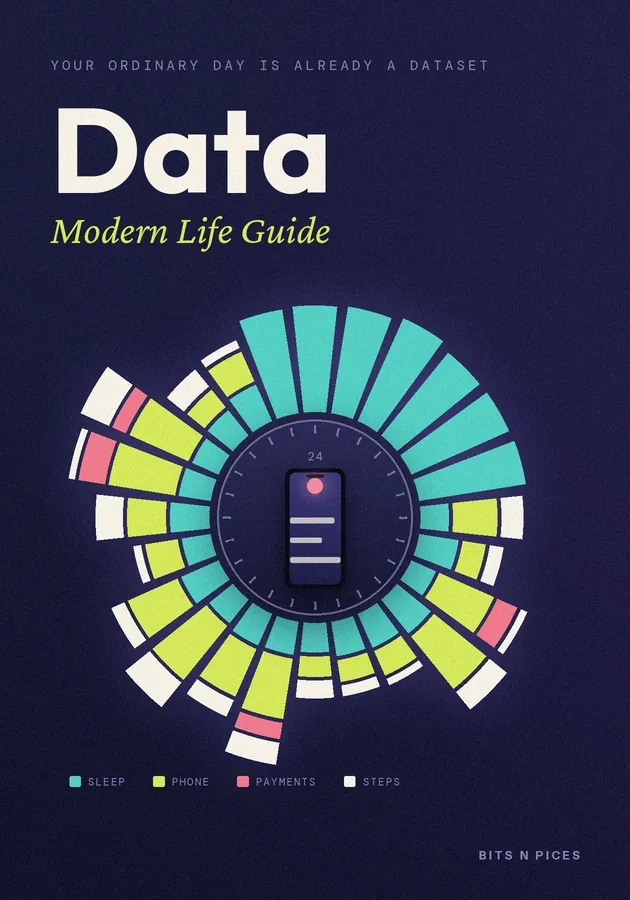
Data: Modern Life Guide
Puntos clave
- Data is simply recorded observations, and your phone, payment apps and smart devices now record a steady stream of them about your ordinary day.
- Before trusting any number, ask who collected it, how it was measured, what it is compared with and what has been left out.
- Relative claims such as 'risk doubles' mean little until you know the absolute numbers underneath, so always ask 'out of how many?'
- A three-column spending sheet reviewed for ten minutes every week tells you more about your money than a budgeting app you never open.
- Review app permissions every few months and switch off location, contacts and microphone access for any app that does not need them to work.
Dentro de este bit
- Your ordinary day is already a dataset
Data is nothing more exotic than recorded observations: a time, a place, an amount, a tap. What changed in the last fifteen years is how many of them get recorded without anyone writing anything down.
- The trade hidden inside free apps
Most free apps are paid for with data rather than money. The app earns by showing you advertising matched to your behaviour, by improving its product from your usage, or sometimes by sharing summaries with partners.
- Reading numbers in a flood of headlines
Information overload means you meet more numbers in a day than your grandparents met in a month, many of them chosen to alarm or impress. Three checks catch most of the tricks.
- Data at work, whatever your job title
Remote and hybrid work turned many jobs into dashboards. Support teams see response times, warehouse shifts see picks per hour, teachers see attendance and marks in an online system, and small shop owners see sales by day in their payment app.
- A household spending sheet that works
Money pressure is where everyday data skills pay back fastest. Banking apps show transactions, but a scrolling list rarely changes behaviour.
- What still holds when every app changes
Apps, dashboards and gadgets will keep changing, but a handful of questions have worked on data for a century and will keep working. Who collected this, and why?
Aprende de seis maneras
Visualizar, Mapa Mental, Práctica, Escenario, Desafío y Repaso están escritos para este libro.
Cuestionario y flashcards
Pon a prueba lo que lees y reténlo con repetición espaciada.
Bits AI
Responde sobre el libro, la sección o la pregunta del cuestionario en la que te encuentras.





