Decision Making: Smart Habits & Practical Skills
Puntos clave
- Turn the household's repeat decisions into standing rules with an exception clause and a review date, so evenings stop being a string of negotiations.
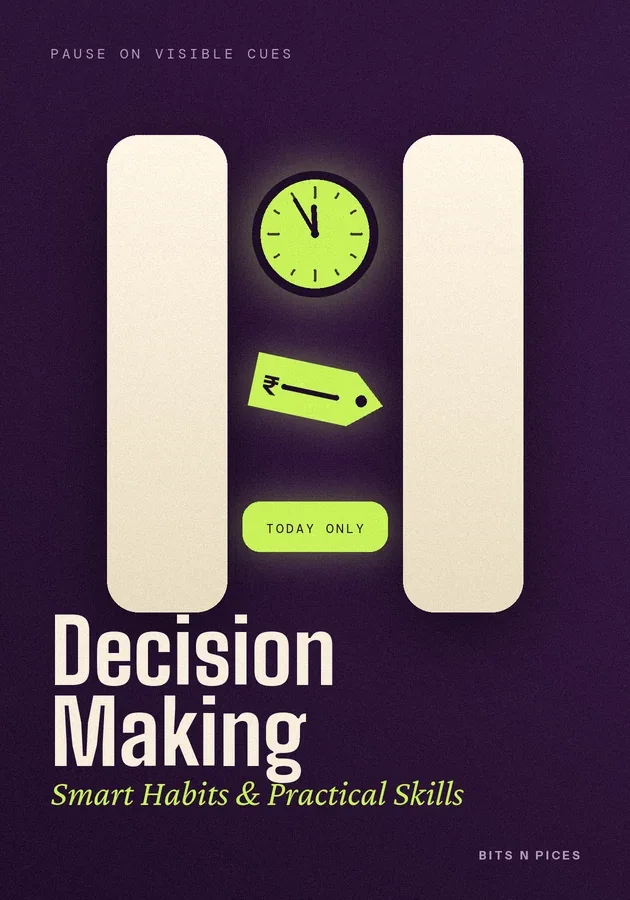
- Write pause cues tied to things you can spot in the moment, such as the clock, a price or a seller saying today only.
- Add friction to rash, costly or irreversible moves and remove it from wise ones, agreeing any friction for children with them first.
- Give each family decision a clear rung, from parent decides to child decides, and move it up as your child shows judgement.
- Keep pending family decisions on a visible board with an owner and a date, and judge past choices by the reasoning used, not the result.
Dentro de este bit
- Decide once so evenings stop being negotiations
A household makes hundreds of small decisions a week, and most of them are the same decisions again: what is for dinner, when screens go off, who showers first, whether a friend can visit on a school night. Each one made fresh costs attention and often an argument.
- Pause cues for the moments that go wrong
Some moments reliably produce poor decisions: late at night, mid-argument, under a seller's pressure, when you are hungry or being watched. A pause cue is an if-then rule that holds the decision until a better moment.
- Friction that slows rash choices, not wise ones
Behaviour follows the easiest path, so arrange the path. Friction is anything that adds a step, a wait or a question before an action.
- Handing decisions to children one rung at a time
Children become good deciders by deciding, but not all at once. A decision-rights ladder makes the handover explicit.
- The decision board and the weekly review
Habits decay unless something maintains them, and a household needs one visible place where decisions live. A decision board is a whiteboard or sheet by the door with three columns: waiting, decided and review on.
- When the system drifts, breaks or backfires
Every household system eventually meets a month it cannot handle: an illness, a move, exams, a new baby. Plan a crisis version in advance, a few standing rules and one pause cue, and park every non-urgent decision in the waiting column until life is calmer.
Aprende de seis maneras
Visualizar, Mapa Mental, Práctica, Escenario, Desafío y Repaso están escritos para este libro.
Cuestionario y flashcards
Pon a prueba lo que lees y reténlo con repetición espaciada.
Bits AI
Responde sobre el libro, la sección o la pregunta del cuestionario en la que te encuentras.