

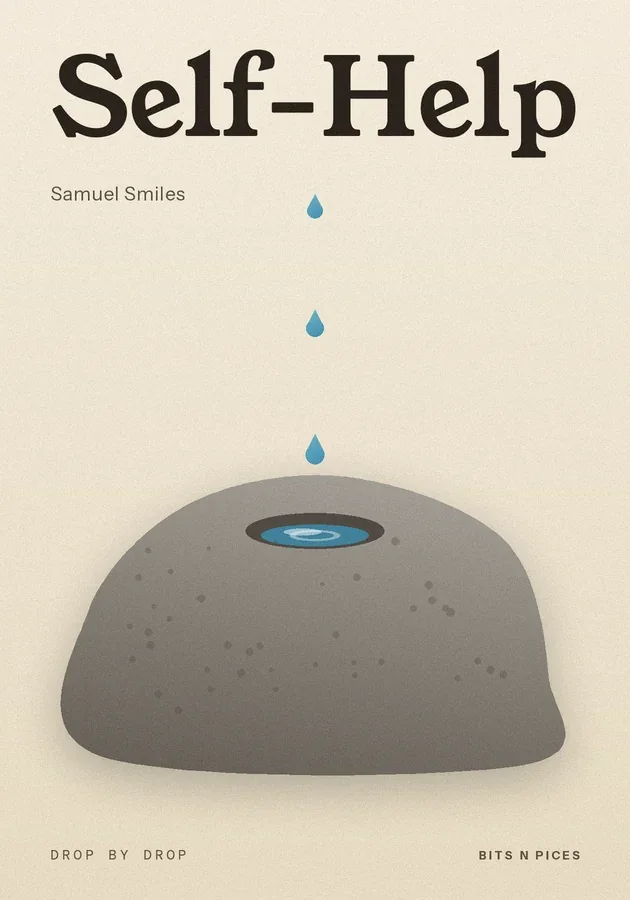
Self-Help
Puntos clave
- El talento común con constancia vence a la brillantez que se rinde
- Los minutos sueltos bien usados suman más que esperar tiempo libre
- Ahorrar, aunque sea poco, te da la libertad de rechazar un mal trato
- El carácter se forja en lo que nadie ve y rinde frutos como confianza
- Tu futuro depende más de tu constancia que de la suerte o los apoyos
Dentro de este bit
- El libro de autoayuda original
Published in 1859, Samuel Smiles's Self-Help gave a whole genre its name, and it sold in huge numbers across Victorian Britain and far beyond, including in Japan and India. Smiles began with lectures to working men in Leeds who had no money and little schooling, and his message was that their future depended less on governments or patrons than on their own diligence, character, and persistence.
- La constancia supera al talento
The heroes of Self-Help are rarely geniuses. Smiles tells of James Watt patiently improving the steam engine over years of failure, George Stephenson teaching himself to read at 18 while working in a colliery, and Josiah Wedgwood experimenting with countless clay mixtures before his pottery succeeded.
- Pequeños esfuerzos, repetidos a diario
Smiles pays close attention to how great work actually happens: not in bursts of inspiration but in the disciplined use of ordinary hours. He describes people who learned languages on their walk to work, scientists who ran experiments before dawn, and writers who filled notebooks in the gaps of a working day.
- Dinero, ahorro e independencia
A long chapter deals with money, and Smiles's view is that saving is less about wealth than about freedom. A person with no reserve must accept whatever terms are offered, while even a small cushion lets you refuse a bad deal, wait for a better job, or survive a setback.
- El carácter es el verdadero capital
For Smiles, the final measure of a life is character: honesty, courtesy, reliability, and the courage to do the right thing when it costs something. He argues that skill without integrity is dangerous and that a reputation for keeping your word is worth more than any single deal.
- Ponlo en práctica
Choose one skill you have been meaning to learn and give it 20 minutes every day this week, in the gaps you already have, such as a commute or the time before breakfast. Set up a small automatic saving, even a tiny one, so that the habit begins before the amount matters.
Aprende de seis maneras
Visualizar, Mapa Mental, Práctica, Escenario, Desafío y Repaso están escritos para este libro.
Narrado
Escucha este bit, leído por Michael o Bella.
Cuestionario y flashcards
Pon a prueba lo que lees y reténlo con repetición espaciada.
Bits AI
Responde sobre el libro, la sección o la pregunta del cuestionario en la que te encuentras.





