

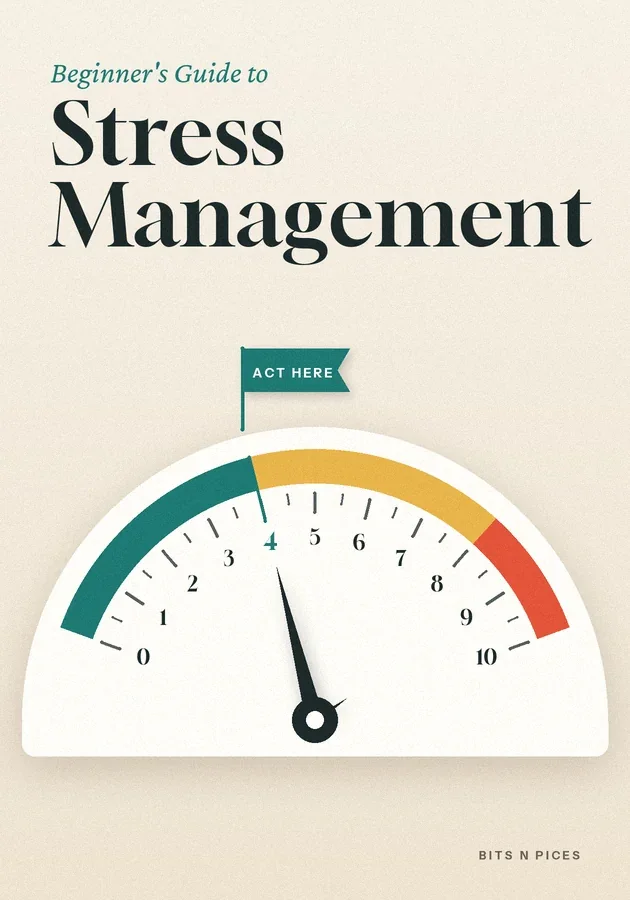
Beginner's Guide to Stress Management
Points clés
- Stress is your body mobilising to meet a demand; the trouble starts when that mobilisation keeps running without enough recovery afterwards.
- Learn your personal stress signature, the body, thought and behaviour signals that show up first, so you can act at four out of ten, not nine.
- Sort every worry into what you control, what you can influence and what you cannot change, then spend your effort on the first two.
- When a problem can be changed, solve it; when it cannot, soothe your body and attention, because using the wrong tool keeps stress going.
- Ask for specific help early, and see a doctor or counsellor when stress stays heavy for weeks or starts affecting sleep, work or relationships.
À l'intérieur de ce bit
- What stress actually is
Stress is the name we give to your body and mind gearing up to meet a demand. The demand is called a stressor: a deadline, an argument, a noisy flat, a bill that arrived early.
- The vocabulary that makes stress workable
A few terms turn a vague feeling into something you can work with. A stressor is the event or condition that makes a demand on you.
- Reading your own early signals
Everyone has a stress signature, a personal set of signals that appear before things get serious. Some show up in the body: a tight jaw, shallow breathing, a knot in the stomach, a headache by late afternoon.
- Your first three moves
Once you can spot stress rising, three moves cover most everyday situations. The first is to sort.
- Beginner mistakes that keep stress going
The first classic mistake is using the wrong tool. If your stress comes from a problem you could fix, such as an unanswered message from your landlord, breathing exercises only postpone it.
- Talking about it and knowing when to get help
Stress shrinks when it is shared well. Vague complaints such as 'everything is too much' leave people unsure how to help.
Apprenez-le de six manières
Visualisation, Carte mentale, Pratique, Scénario, Défi et Révision sont disponibles pour ce livre.
Quiz et cartes mémoire
Testez ce que vous avez lu et retenez-le grâce à la répétition espacée.
Bits AI
Il répond sur le livre, la section ou la question de quiz sur laquelle vous vous trouvez.





