

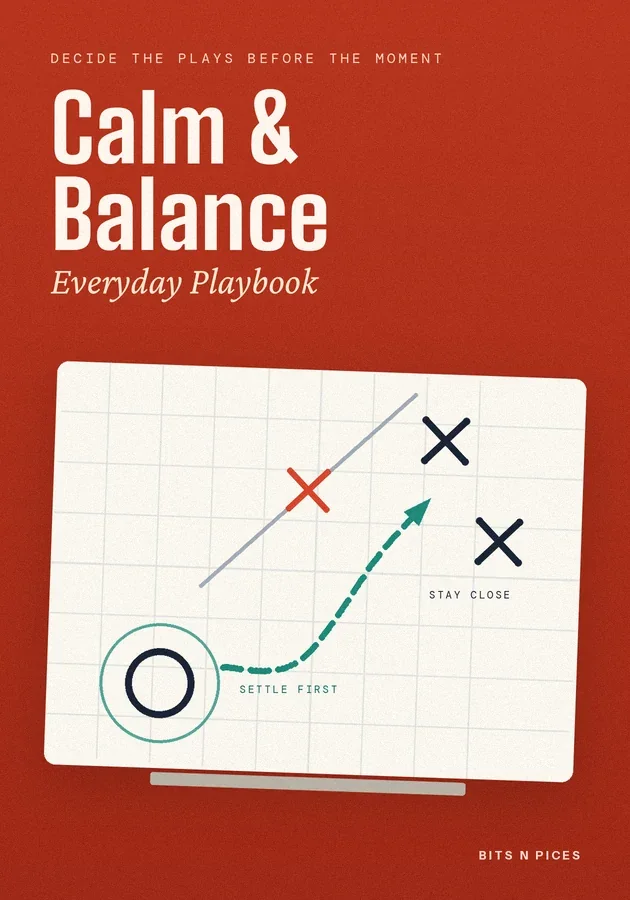
Calm & Balance: Everyday Playbook
Points clés
- Settle yourself before you handle a child's big feeling, because children borrow the adult's state before they hear a single word.
- Decide your family's rules in calm moments, such as one priority per evening, so you are not inventing policy mid-meltdown.
- During a meltdown, keep everyone safe, stay close and use very few words; save lessons and consequences for later, once bodies have settled.
- When adults disagree in front of children, pause the argument, finish it privately and let the children see that it ended well.
- Plan for empty-tank days with a tag-out partner and a lower-bar evening, and bring in a teacher or doctor when patterns persist.
À l'intérieur de ce bit
- Decide the plays before the moment arrives
A playbook is a set of decisions made in advance, so that in the heat of the moment you choose from a short list rather than inventing a response with your pulse racing. Two rules sit above every play in this book.
- Play for a fight between siblings
When siblings clash, the instinct is to act as judge: find out who started it and hand down a verdict. The play is to be a referee who coaches instead.
- Play for a meltdown or a slammed door
In a full meltdown, reasoning cannot land, because the child's alarm has temporarily taken over from their thinking. The play is safety, closeness and very few words.
- Play for when the adults disagree
Children notice adult tension long before anyone raises a voice. The play is not to hide every disagreement but to manage its shape.
- Play for the evening crunch
Between school pick-up and bedtime, many families hit their hardest stretch: homework, dinner, screens, baths and tired bodies all at once. The play is a decision rule made in advance: one priority per evening.
- Empty tanks and calling in help
A playbook fails if the person running it is exhausted, so plan for empty-tank days in advance. Agree a tag-out signal with another adult, such as a partner or grandparent, meaning take over for fifteen minutes, no questions asked.
Apprenez-le de six manières
Visualisation, Carte mentale, Pratique, Scénario, Défi et Révision sont disponibles pour ce livre.
Quiz et cartes mémoire
Testez ce que vous avez lu et retenez-le grâce à la répétition espacée.
Bits AI
Il répond sur le livre, la section ou la question de quiz sur laquelle vous vous trouvez.





