Decision Making Made Simple
Points clés
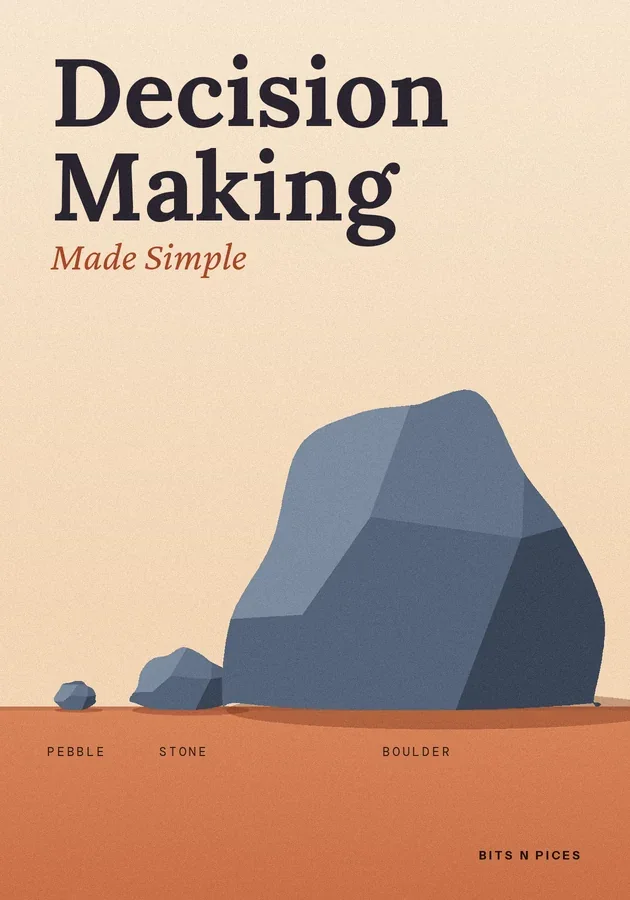
- Sort each choice as a pebble, a stone or a boulder, and save your slow, careful thinking for the few boulders that are hard to undo.
- When a choice comes with too many options, pick one filter, such as free or close to home, and cut the list to three before choosing.
- When you are stuck between two options, look for a third, then ask one question: what matters most here?
- Most everyday choices have several good-enough answers, so stop searching once an option clearly does the job instead of hunting for the perfect one.
- Teach children the three sizes and pause stories to ask what a character could choose, so they practise deciding where mistakes cost nothing.
À l'intérieur de ce bit
- Why deciding feels so hard at home
Parents are often told they make too many decisions. Just as often, the real trouble is too many options inside each one.
- Four myths that make deciding harder
Myth one: there is one right answer, and your job is to find it. Most everyday choices have several good-enough answers, and chasing the perfect one mostly produces delay.
- Pebble, stone or boulder: the one sort
If you keep one idea from this book, keep this one. Before deciding anything, ask how heavy it is.
- The simple method: three options, one question
When you feel stuck, you are usually stuck between two options, each with a drawback. The first move is to find a third.
- Giving children the three sizes
Children have the same sorting problem as adults, only louder. A seven-year-old can sob for twenty minutes over the colour of a pencil case, then agree in two seconds to a friend's dare to climb the school wall.
- A family habit: pause the story
Children practise deciding most easily on someone else's choices, because nothing is at stake for them. Stories give you endless material.
Apprenez-le de six manières
Visualisation, Carte mentale, Pratique, Scénario, Défi et Révision sont disponibles pour ce livre.
Quiz et cartes mémoire
Testez ce que vous avez lu et retenez-le grâce à la répétition espacée.
Bits AI
Il répond sur le livre, la section ou la question de quiz sur laquelle vous vous trouvez.