Decision Making: Modern Life Guide
Points clés
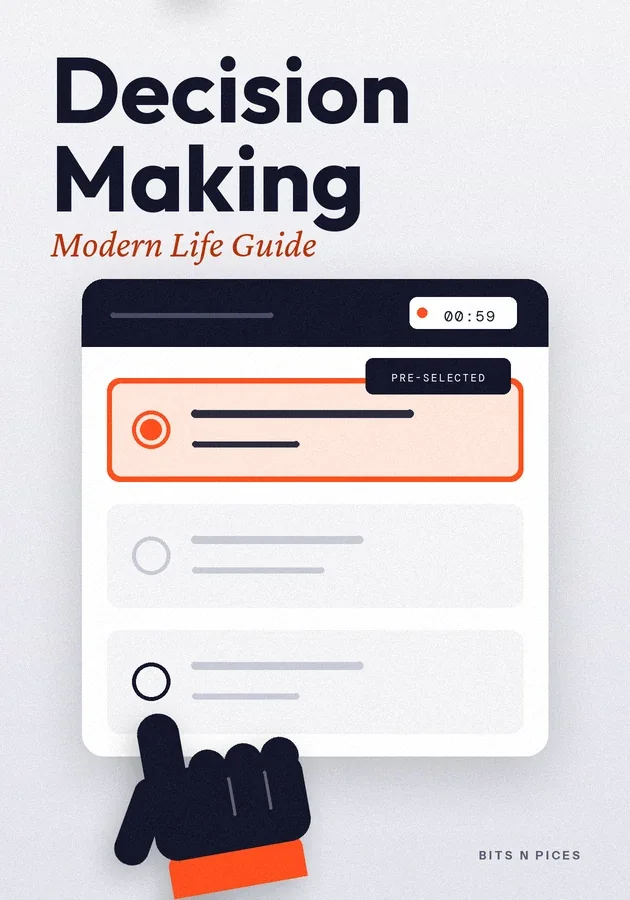
- Most screens you choose on were arranged by someone who benefits, so ask whether you would pick an option if it were not already selected.
- Before any instalment or monthly plan, write the full price and the month it ends, and count it as future pay already spent.
- In remote teams, record each shared decision in a short note naming the owner, the reason and a date to revisit it.
- Use family group chats to gather facts and views, but agree who decides and how before the discussion starts.
- Set a research deadline and a fixed circle of about three trusted sources before you start, then decide with what you have when time is up.
À l'intérieur de ce bit
- What changed about choosing, and what did not
Three things changed within a single generation. Options multiplied: where a shop once held four kettles, a screen now offers four hundred, each with reviews.
- Defaults, rankings and the countdown clock
Every screen you choose on was arranged by someone. Three design features do most of the work.
- Money pressure and the one-tap economy
Paying has become almost frictionless. Pay-later buttons, easy monthly instalments and saved cards mean a large purchase can be completed before the thought is finished.
- Deciding at work without the corridor
Remote and hybrid work moved many decisions into chat threads and video calls, and something was lost on the way. In an office, a decision had a room, a time and faces nodding.
- Family choices in the group chat
Family decisions now happen in group chats spanning several cities and three generations, often all at once. The advantages are real: everyone is informed, and relatives abroad can take part.
- Enough information, and when to stop looking
The modern risk is rarely too little information. It is endless research that feels productive while postponing the choice.
Apprenez-le de six manières
Visualisation, Carte mentale, Pratique, Scénario, Défi et Révision sont disponibles pour ce livre.
Quiz et cartes mémoire
Testez ce que vous avez lu et retenez-le grâce à la répétition espacée.
Bits AI
Il répond sur le livre, la section ou la question de quiz sur laquelle vous vous trouvez.