

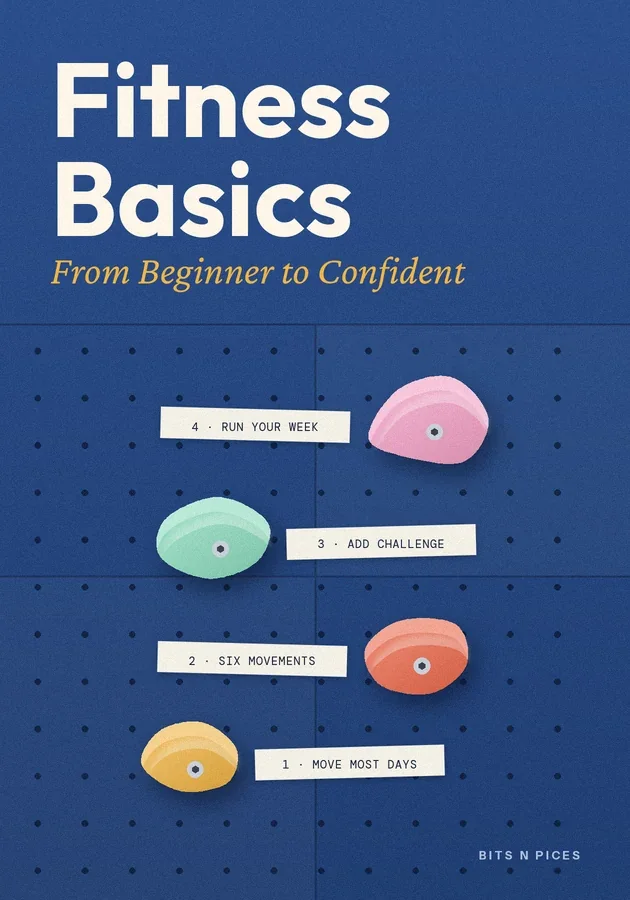
Fitness Basics: From Beginner to Confident
Points clés
- Confidence in fitness is a ladder: move most days, learn the basic movement patterns, add challenge on purpose, then plan and adjust your own week.
- Find your starting rung with three honest checks, a brisk walk, standing up from a chair and wall push-ups, and begin a little easier than pride suggests.
- Practise deliberately with one technique cue per session, slow controlled repetitions and a phone video that shows what you actually did rather than what you felt.
- Progress by changing one thing at a time, such as more repetitions or a slower lowering, and end most sets with two or three repetitions in reserve.
- Chest pain, dizziness, unusual breathlessness or sharp joint pain mean stop and get checked, while tender muscles a day or two later are the body adapting.
À l'intérieur de ce bit
- Four rungs between you and confident
Fitness can look like one enormous skill that other people were born with. It is easier to see it as a ladder with four rungs.
- Rung one: moving on most days
The first rung is about frequency, not intensity. The goal is to make movement a normal part of most days through walking, climbing stairs, cycling to the market or dancing in the kitchen.
- Rung two: learning the six basic movements
Almost every exercise you will ever see is a version of six movement patterns. A squat is sitting down and standing up.
- Rung three: adding challenge on purpose
Your body adapts to exactly what you ask of it, and then it stops adapting. Progressive overload means gradually asking for a little more so the improvements continue.
- Rung four: running your own week
The top rung is independence: you can plan a week, fit it around real life and adjust when things go wrong. A common public-health guideline for adults is around 150 minutes of moderate activity a week, plus muscle-strengthening work on two or more days.
- Proof you have climbed, and knowing when to stop
Feelings are unreliable judges of progress, so every four weeks repeat the checks from the start, the walk, the chair stands and the wall push-ups, done the same way. Grace, a primary-school teacher in Kampala, went from six chair stands to fifteen in two months and could explain her squat cue to her sister.
Apprenez-le de six manières
Visualisation, Carte mentale, Pratique, Scénario, Défi et Révision sont disponibles pour ce livre.
Quiz et cartes mémoire
Testez ce que vous avez lu et retenez-le grâce à la répétition espacée.
Bits AI
Il répond sur le livre, la section ou la question de quiz sur laquelle vous vous trouvez.





