

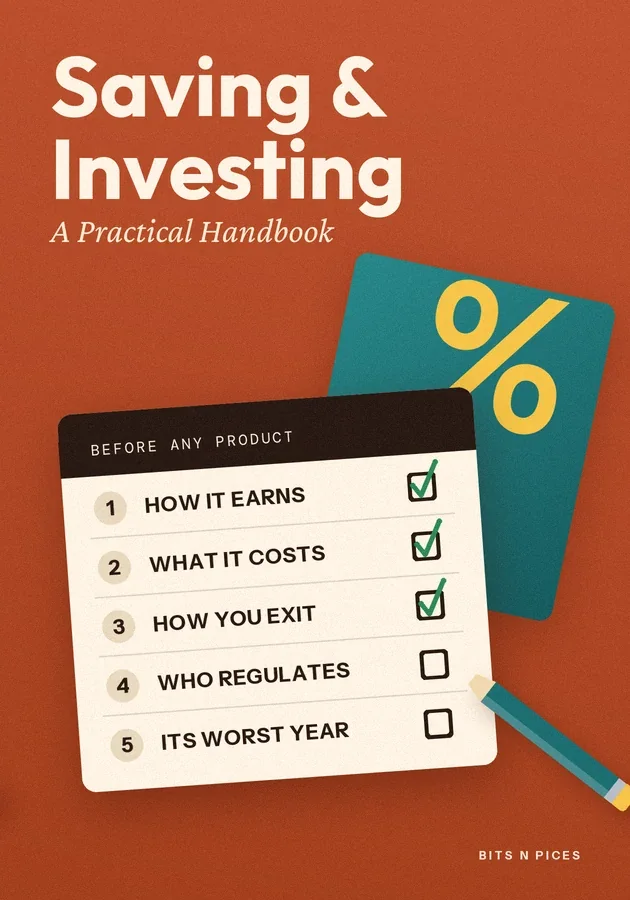
Saving & Investing: A Practical Handbook
Points clés
- Start with a one-page family money map listing every account, debt and goal with a date, so decisions are made from facts rather than worry.
- Size the emergency fund from essential monthly costs, keep it in a separate easy-access account and fill it with an automatic transfer on payday.
- Turn each goal into a monthly figure by working backwards from the amount and the date, and keep goals under three years in safe savings.
- Before buying any product, ask how it earns, what it costs, how you exit, who regulates the seller and what its worst year looked like.
- Let children watch the family plan work in age-appropriate ways, such as a goal chart, a small savings match or a look at a statement.
À l'intérieur de ce bit
- Map the family's money in one evening
Every workable plan starts with an honest picture, and you can draw it in one evening. Take a single sheet and make four boxes.
- Build the emergency fund step by step
An emergency fund is money kept only for genuine shocks: a lost job, a medical bill, an urgent repair. Build it in five steps.
- Turn every goal into a monthly number
A goal without a monthly figure is a wish. Use one sentence as a template: for this goal, by this date, we need this amount, so we set aside this much a month.
- The five-question check before any product
Families are offered financial products everywhere: at bank counters, school events, on the phone and from relatives. Before signing anything, run the same five questions and write down the answers.
- Automate, then review on a calendar
Good intentions fade; standing instructions do not. Set payday transfers in this order: emergency fund until full, then each goal account, then long-term investments, and only then the spending account.
- Bringing the children into the plan
Children learn saving by watching it work, so let them see the parts of the plan that fit their age. For under-sevens, a clear jar with a picture of the goal taped to it makes progress visible.
Apprenez-le de six manières
Visualisation, Carte mentale, Pratique, Scénario, Défi et Révision sont disponibles pour ce livre.
Quiz et cartes mémoire
Testez ce que vous avez lu et retenez-le grâce à la répétition espacée.
Bits AI
Il répond sur le livre, la section ou la question de quiz sur laquelle vous vous trouvez.





