

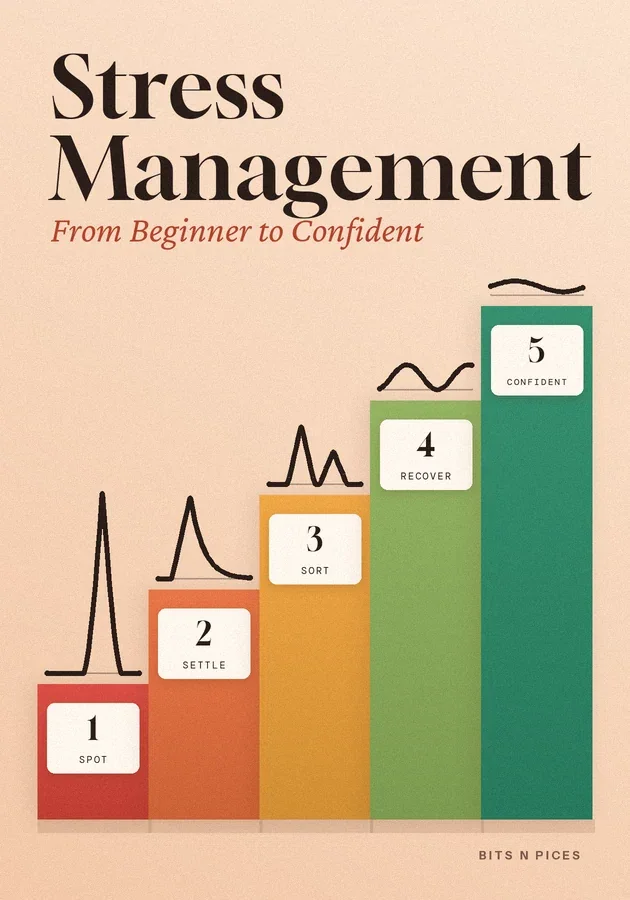
Stress Management: From Beginner to Confident
Points clés
- Stress is your body's alarm system: short bursts sharpen you, but an alarm that never switches off is what wears you down.
- The first rung is noticing, so learn your personal early signals and aim to catch stress at about four out of ten, not eight.
- Practise one settling tool, such as an out-breath longer than the in-breath, while you are calm so it is ready when you are not.
- Sort every worry into what you can change and what you cannot, then take one small step or consciously set the rest aside.
- You have climbed a rung when you use a skill without being reminded, and confidence includes asking for help before you are overwhelmed.
À l'intérieur de ce bit
- What stress is and why it is a skill
Stress is the body's alarm system. When your brain decides something matters and might be hard, it releases hormones that quicken your heart, sharpen your attention and send energy to your muscles.
- Rung one: spotting stress before it peaks
Most beginners notice stress only at its peak, when they are already shouting, crying or lying awake. The first rung is learning your early signals, which show up in three places.
- Rung two: settling your body in the moment
Once you can notice stress, the next rung is having a way to turn the alarm down. The simplest tool is your breath.
- Rung three: sorting what you can change
Settling the body buys you a clearer minute. The third rung is using that minute to sort the problem.
- Rung four: building recovery into ordinary days
Stress is not the real enemy; stress without recovery is. Think of a phone battery.
- Rung five: confidence, support and your limits
Confidence does not mean feeling no stress. It means you see peaks coming, have a plan, bounce back faster and ask for help early.
Apprenez-le de six manières
Visualisation, Carte mentale, Pratique, Scénario, Défi et Révision sont disponibles pour ce livre.
Quiz et cartes mémoire
Testez ce que vous avez lu et retenez-le grâce à la répétition espacée.
Bits AI
Il répond sur le livre, la section ou la question de quiz sur laquelle vous vous trouvez.





