Decision Making Made Simple
Punti chiave
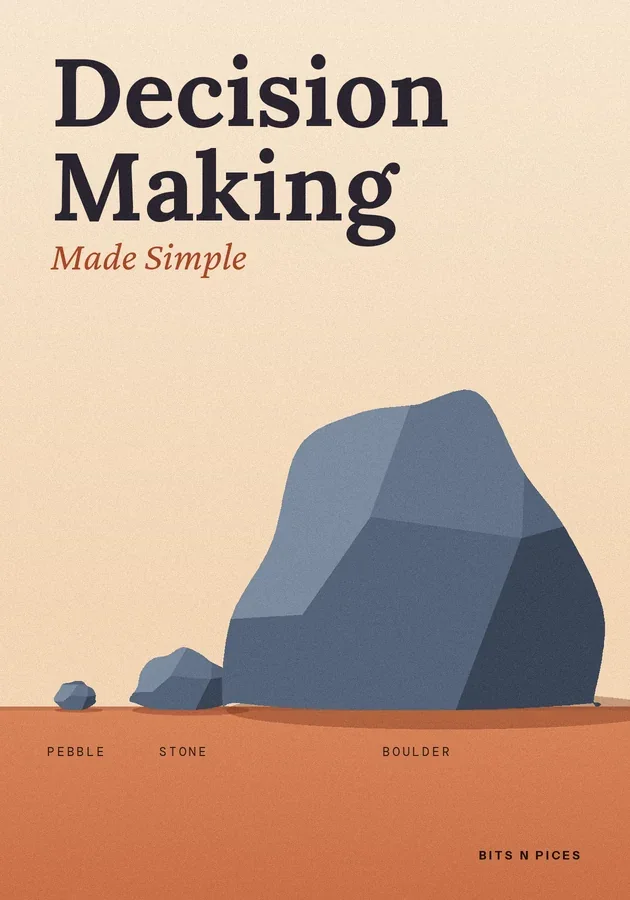
- Sort each choice as a pebble, a stone or a boulder, and save your slow, careful thinking for the few boulders that are hard to undo.
- When a choice comes with too many options, pick one filter, such as free or close to home, and cut the list to three before choosing.
- When you are stuck between two options, look for a third, then ask one question: what matters most here?
- Most everyday choices have several good-enough answers, so stop searching once an option clearly does the job instead of hunting for the perfect one.
- Teach children the three sizes and pause stories to ask what a character could choose, so they practise deciding where mistakes cost nothing.
All'interno di questo bit
- Why deciding feels so hard at home
Parents are often told they make too many decisions. Just as often, the real trouble is too many options inside each one.
- Four myths that make deciding harder
Myth one: there is one right answer, and your job is to find it. Most everyday choices have several good-enough answers, and chasing the perfect one mostly produces delay.
- Pebble, stone or boulder: the one sort
If you keep one idea from this book, keep this one. Before deciding anything, ask how heavy it is.
- The simple method: three options, one question
When you feel stuck, you are usually stuck between two options, each with a drawback. The first move is to find a third.
- Giving children the three sizes
Children have the same sorting problem as adults, only louder. A seven-year-old can sob for twenty minutes over the colour of a pencil case, then agree in two seconds to a friend's dare to climb the school wall.
- A family habit: pause the story
Children practise deciding most easily on someone else's choices, because nothing is at stake for them. Stories give you endless material.
Impara in sei modi
Visualizza, Mappa Mentale, Pratica, Scenario, Sfida e Ripasso sono stati scritti per questo libro.
Quiz e flashcard
Metti alla prova ciò che hai letto e memorizzalo con la ripetizione spaziata.
Bits AI
Risponde riguardo al libro, alla sezione o alla domanda del quiz su cui ti trovi.