

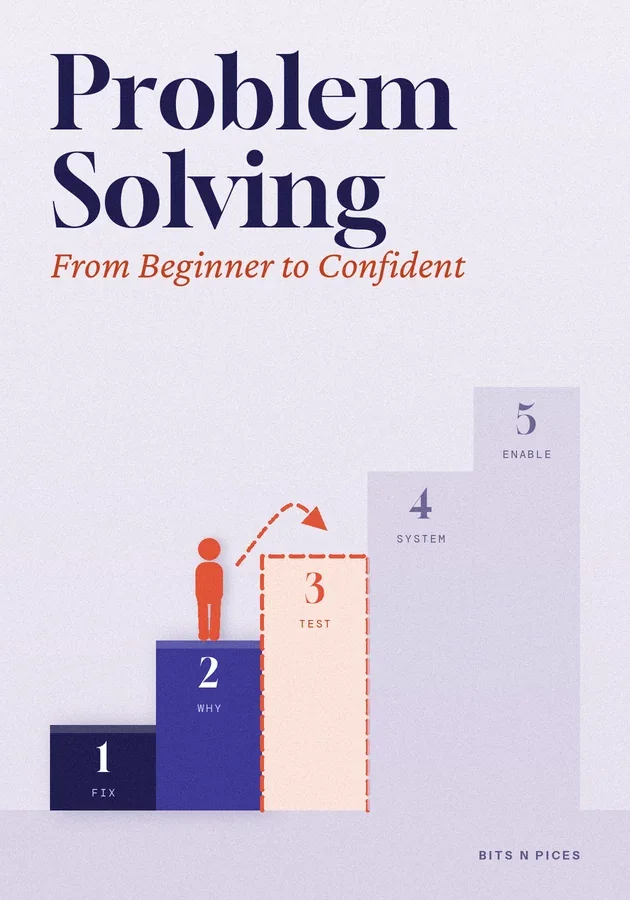
Problem Solving: From Beginner to Confident
Punti chiave
- Place yourself honestly on one rung, from quick fixer to enabler, and practise only the move to the next rung, not the top.
- When a problem comes and goes, log every occurrence and its conditions, because intermittent faults often have two causes that each appear only sometimes.
- Before a pilot, imagine it has already failed and list why, then test the riskiest assumption first, cheaply, before anything depends on it.
- Every fix disturbs something else, so ask who it affects, what people will do differently and what might happen weeks later, especially with targets.
- Keep a prediction log of your first guesses about causes; a rising hit rate is better proof of progress than feeling confident.
All'interno di questo bit
- Five rungs from quick fixer to enabler
Confidence in problem solving is not a feeling; it is a track record of fixes that stay fixed. There are five rungs.
- From fixing things to finding out why
The move from the first rung to the second is one habit: write the problem and your guess at its cause before you act, then check the guess. It sounds slow.
- Designing options and testing the riskiest first
At the third rung the question shifts from what is wrong to what could we do, and how would we know it works? Designers produce options that differ in kind, not just in size.
- Seeing the system around the problem
The fourth rung starts with an uncomfortable idea: every fix disturbs something else. A second-order effect is a consequence beyond the one you intended, often somewhere else or later.
- Solving problems through other people
The top rung is less about solving and more about deciding what gets solved, and by whom. An enabler notices that being the person who fixes everything creates a bottleneck, and that a team stops thinking whenever the fixer walks in.
- Deliberate practice and the prediction log
Deliberate practice means working at the edge of your ability with feedback, not repeating what you already do well. For problem solving, that means choosing one problem a week because it is slightly too hard for you, working it through fully and reviewing it afterwards: what did I think, what was true, and what would I do differently?
Impara in sei modi
Visualizza, Mappa Mentale, Pratica, Scenario, Sfida e Ripasso sono stati scritti per questo libro.
Quiz e flashcard
Metti alla prova ciò che hai letto e memorizzalo con la ripetizione spaziata.
Bits AI
Risponde riguardo al libro, alla sezione o alla domanda del quiz su cui ti trovi.





