

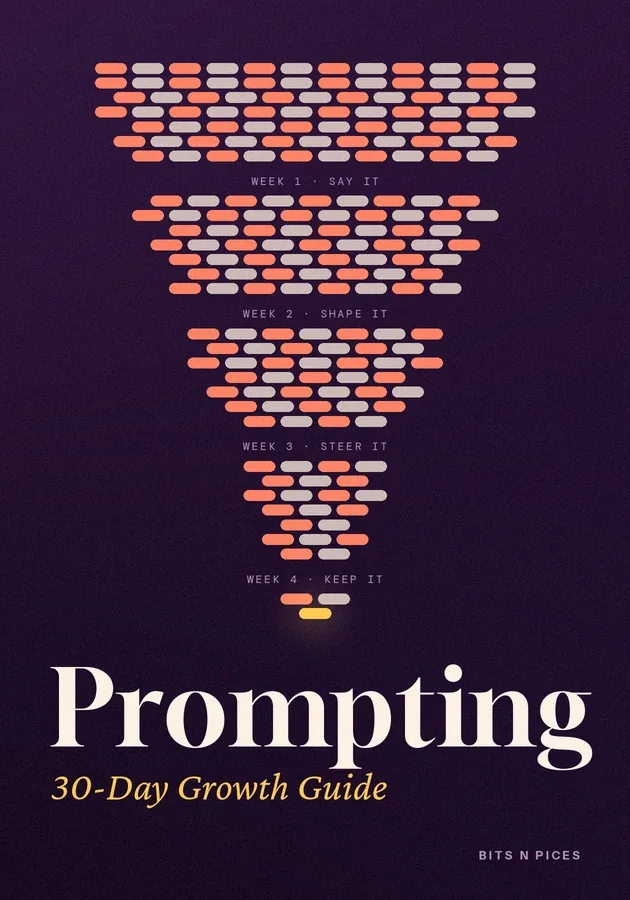
Prompting: 30-Day Growth Guide
Punti chiave
- Ten minutes a day on real tasks, in one fixed slot, builds prompting skill faster than occasional long sessions with made-up questions.
- Week one teaches you to say what you want and who it is for; week two teaches you to shape what comes back.
- Week three adds steering, checking and privacy, so a good-looking reply never goes out unexamined or carrying someone's private details.
- In week four, build one keeper prompt for a real weekly job, test it on three different inputs and save it with a name.
- Track turns-to-usable every day, re-run your day-one prompts on day twenty-eight, and rescue a slipped week by shrinking it rather than restarting.
All'interno di questo bit
- Before day one: a slot, a log, a baseline
This programme runs for four weeks, with one theme a week and one small action a day, each taking about ten minutes. The rule that makes it work is that every action uses a real task from your life, never a made-up question.
- Week one: say what you want and for whom
A prompt is simply the message you type to the tool. The tool knows only what is in that message and the chat so far: not your reader, not your deadline, not the facts of your situation.
- Week two: shape what comes back
Once the tool knows what you want, week two controls the form of the answer. Day eight names a format: a table with three columns, a numbered list of five, or two short paragraphs.
- Week three: steer, check and protect
Week three is about what happens after the reply arrives. Steering means improving a reply with a follow-up message, such as 'keep the first line, make it warmer, add the Friday deadline', instead of starting again.
- Week four: build one prompt worth keeping
The last week turns practice into something you will use every week afterwards: a keeper prompt. This is a saved prompt for a recurring job, written with everything from weeks one to three and with blanks, in square brackets, for the parts that change.
- Reading your log and recovering lost days
Your log answers the question every learner asks: am I actually getting better? Look at three things at the end of each week.
Impara in sei modi
Visualizza, Mappa Mentale, Pratica, Scenario, Sfida e Ripasso sono stati scritti per questo libro.
Quiz e flashcard
Metti alla prova ciò che hai letto e memorizzalo con la ripetizione spaziata.
Bits AI
Risponde riguardo al libro, alla sezione o alla domanda del quiz su cui ti trovi.





