

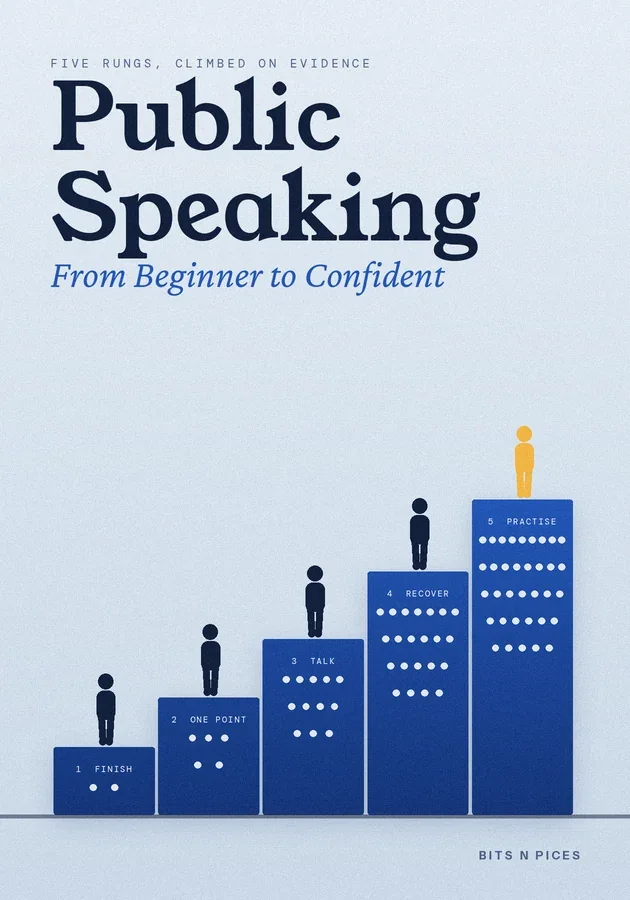
Public Speaking: From Beginner to Confident
Punti chiave
- Confidence in speaking is built from evidence you can see, so climb one rung at a time and move up only when you have the proof.
- On the first rung the only goal is finishing: speak for two minutes to a few people and keep going through every stumble.
- Before any talk, write your point as one sentence a listener could repeat, then choose three supports: a reason, an example and a number.
- Swap your script for a card of key words, pause at every full stop and give each sentence to one listener's eyes.
- When a question lands, give a one-sentence headline answer, add one reason or example, then bridge straight back to your talk.
All'interno di questo bit
- Five rungs between nervous and confident
Most beginners believe confident speakers were born that way. In practice, confidence is a pile of evidence: talks you finished, points people remembered, questions you survived.
- Rung one: from freezing to finishing
On the first rung, the only goal is to reach the end. Polish, humour and eye contact can wait.
- Rung two: from rambling to one clear point
Once you can finish, the next problem is usually that listeners cannot tell what you meant. Rambling is not a personality flaw; it is what happens when a speaker has not decided the point.
- Rung three: from reading aloud to talking
Many people on rung two write a careful script and then read it, eyes down, in a flat voice. Rung three is the move from reading to talking.
- Rung four: when things do not go to plan
Rung four is handling questions, interruptions and blanks without losing your thread. For questions, use headline, reason, return: answer in one sentence first, add one reason or example, then bridge back to your talk.
- Deliberate practice and proof you have climbed
Rung five is not about never feeling nervous. Confident speakers prepare quickly, notice the room and adjust, cutting a section when attention drops or adding an example when faces look puzzled.
Impara in sei modi
Visualizza, Mappa Mentale, Pratica, Scenario, Sfida e Ripasso sono stati scritti per questo libro.
Quiz e flashcard
Metti alla prova ciò che hai letto e memorizzalo con la ripetizione spaziata.
Bits AI
Risponde riguardo al libro, alla sezione o alla domanda del quiz su cui ti trovi.





