

핵심 요약
- Burnout arrives in three strands, exhaustion, distance and a shrinking sense of competence, so learn which strand tends to show up first in you.
- Every Friday, list three heavy demands and three strong resources and score the balance; after a month, trust the trend over your memory.
- Match recovery to the drain: people-heavy days usually need quiet, while dull, passive days often need an absorbing challenge rather than more rest.
- Answer new requests with trade-off language that names which current task moves, so the cost of every yes is visible to the person asking.
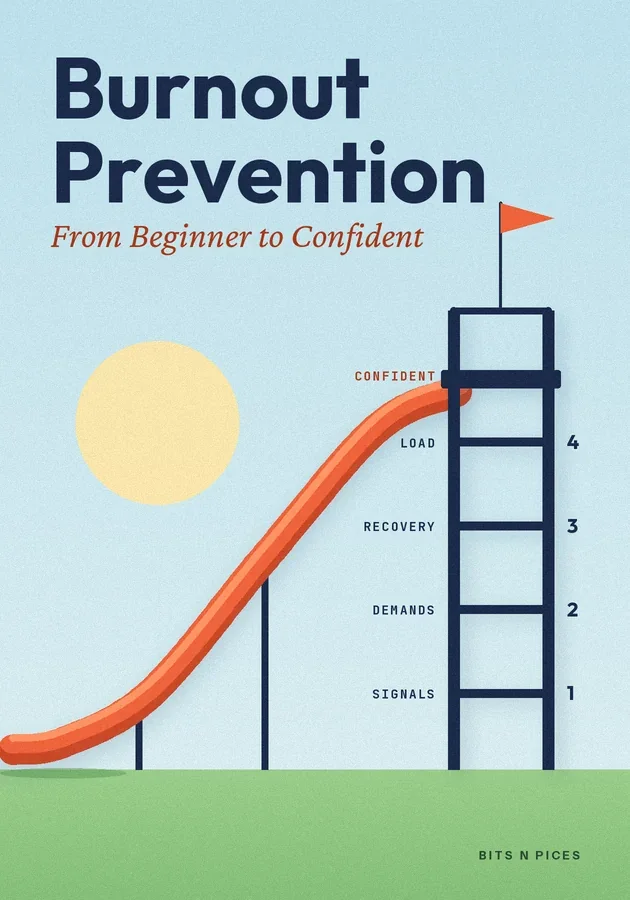
- Rate yourself on each rung, practise the lowest one for a month, and see a doctor or counsellor if exhaustion or low mood persists.
이 비트의 내용
- Burnout is a slow slide, not a fall
Burnout is the state you reach when demanding work, paid or unpaid, drains you for months faster than you can refill. Three strands usually travel together: an exhaustion that sleep no longer fixes, a growing distance or cynicism towards the work and the people in it, and a shrinking sense that you are any good at what you do.
- Rung one: reading your own early signals
The first rung is noticing, and it is harder than it sounds because early signals are personal and quiet. For one person it is skipping lunch without deciding to; for another it is rereading the same email three times, snapping in a queue, or losing interest in a hobby that used to be automatic.
- Rung two: measuring demands against resources
Noticing tells you something is wrong; measuring tells you why. Picture each week as a ledger with two columns.
- Rung three: recovering on purpose, not by accident
Recovery is not the same as stopping work, and at this rung you plan it at three scales. Micro-recovery is a few minutes between tasks: standing, stretching, a walk to refill your water.
- Rung four: changing the load, not just coping
Recovery alone cannot keep pace with a load that keeps growing, so the fourth rung is shaping the work itself. The core tool is trade-off language.
- Confident: hard cases, other people and your next rung
Confidence shows in the awkward cases. Passion work is risky because you rarely want to stop; caring roles are risky because stopping feels like abandoning someone; long crunch seasons are risky because they make running empty feel normal.
여섯 가지 방법으로 배우기
이 책을 위해 시각화, 마인드맵, 연습, 시나리오, 챌린지, 복습 기능이 준비되어 있어요.
퀴즈와 플래시카드
읽은 내용을 테스트하고 간격 반복으로 확실히 기억하세요.
Bits AI
보고 있는 책, 섹션, 퀴즈 질문에 대해 답변해 줍니다.





