

핵심 요약
- Start with a cold test and a prediction of your score, because the gap between the two shows how well you judge your own learning.
- Spend most of each session pulling ideas out of memory rather than putting them back in; recall that feels effortful is the kind that lasts.
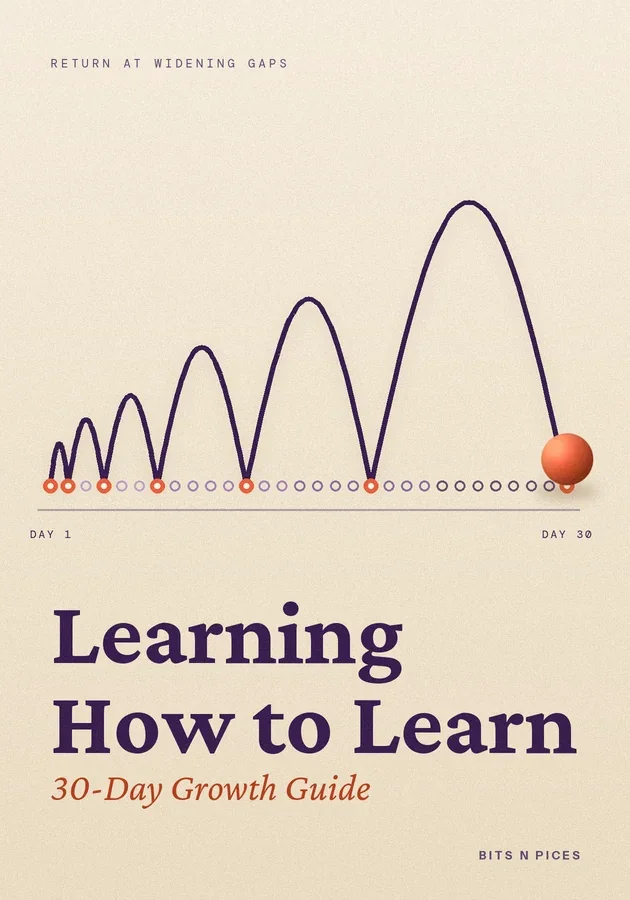
- Schedule reviews at widening gaps, such as the next day, three days later and a week later, and let a little forgetting happen between them.
- In the second half of the month, mix problem types and explain each answer aloud, so you learn to choose a method, not just follow one.
- When a week slips, shrink the day to a five-minute recall and resume where you stopped; never restart from day one or double the load.
이 비트의 내용
- Day zero: set a target and a baseline
A thirty-day programme needs a starting line you can measure against, so spend day zero choosing one skill and testing yourself on it cold. Pick something narrow enough to check in ten minutes: reading a balance sheet, forming Portuguese verbs in the past tense, sizing cable for a household circuit.
- Week one: retrieval before rereading
Week one has a single theme, retrieval, and a single daily micro-action that takes about ten minutes. Close the book, take a blank page and write everything you remember about yesterday's material, including examples and rough diagrams.
- Week two: spacing, forgetting and the calendar
Week two adds spacing. Instead of reviewing a topic every day, you review it at widening gaps: the next day, three days later, then a week later.
- Week three: mix the problems and explain
Most practice books group problems by type, so you know the method before you read the question. Real tests and real work do not.
- Week four: transfer, teaching and final tests
The last week moves from practice to use. Transfer means applying what you learned to a situation that looks different from the ones you rehearsed.
- When a week slips, and what to measure
Every thirty-day plan meets a bad week: a stock-take at work, a sick child, a family wedding. The rule is to shrink rather than stop.
여섯 가지 방법으로 배우기
이 책을 위해 시각화, 마인드맵, 연습, 시나리오, 챌린지, 복습 기능이 준비되어 있어요.
퀴즈와 플래시카드
읽은 내용을 테스트하고 간격 반복으로 확실히 기억하세요.
Bits AI
보고 있는 책, 섹션, 퀴즈 질문에 대해 답변해 줍니다.





