

핵심 요약
- Run the thirty days on one real project of four to eight weeks, because live work teaches judgement that practice exercises never will.
- In week one, write measurable success criteria and an out-of-scope list before any plan, since most overruns start with a fuzzy edge.
- Estimate uncertain tasks with best, likely and worst cases, and keep one visible buffer instead of hiding padding inside every task.
- Tie red, amber and green status to rules agreed in advance, so a report reflects the facts rather than how the week felt.
- When a week slips, do its minimum version in two sittings and carry one action forward instead of restarting from day one.
이 비트의 내용
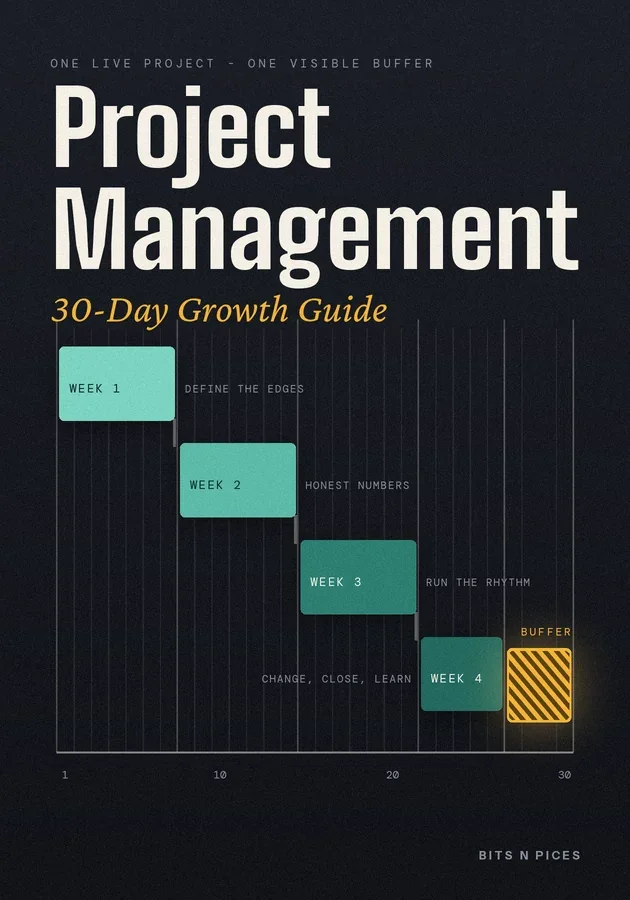
- How the thirty days are built
This programme assumes you know the basics, such as tasks, milestones and stakeholders, and want the judgement that comes from using them under pressure. So it runs on a live project, not an exercise.
- Week one: define the edges
Most overruns start in week one, not week three. Day one: write the problem the project solves and why now.
- Week two: plan with honest numbers
Break the charter into deliverables, then into tasks of one to three days. For each uncertain task, write three estimates: best case, most likely and worst case.
- Week three: run the rhythm
Running a project is mostly rhythm: a ten-minute daily check on what moved and what is stuck, a fifteen-minute weekly check-in with the people doing the work, and a short written status for your sponsor. Keep a risk register in which every risk has an owner and a trigger, the sign that it is starting to happen, plus a one-line-per-decision log so nobody relies on memory later.
- Week four: change, close and learn
Late in a project, requests arrive faster. Treat each the same way: log it, write a short note on its impact on time, cost, scope and quality, and let the sponsor decide.
- Measuring progress and rescuing a slipped week
Measure the project and yourself. Each Friday note three things: how far the forecast end date moved, how many open risks have an owner and a next step, and how often a stakeholder heard bad news late.
여섯 가지 방법으로 배우기
이 책을 위해 시각화, 마인드맵, 연습, 시나리오, 챌린지, 복습 기능이 준비되어 있어요.
퀴즈와 플래시카드
읽은 내용을 테스트하고 간격 반복으로 확실히 기억하세요.
Bits AI
보고 있는 책, 섹션, 퀴즈 질문에 대해 답변해 줍니다.





