

핵심 요약
- Every project rests on six linked ideas, outcome, trade-offs, time, uncertainty, people and method, and a weakness in one shows up in the others.
- Agree with the sponsor which constraint is fixed and which will flex, because quietly cutting quality to hold a date usually returns as rework.
- Protect the finish date with a pooled buffer and extra care where paths merge, rather than padding every task and watching the padding vanish.
- Give estimates as ranges, keep a contingency for risks nobody has named yet, and expect the range to narrow as real work replaces guesses.
- Choose a plan-first or short-cycle approach by how stable the requirements are and how costly late change would be, not by fashion.
이 비트의 내용
- The map: six ideas and how they connect
Most of project management can be organised under six ideas. Outcome is what the project must achieve and for whom.
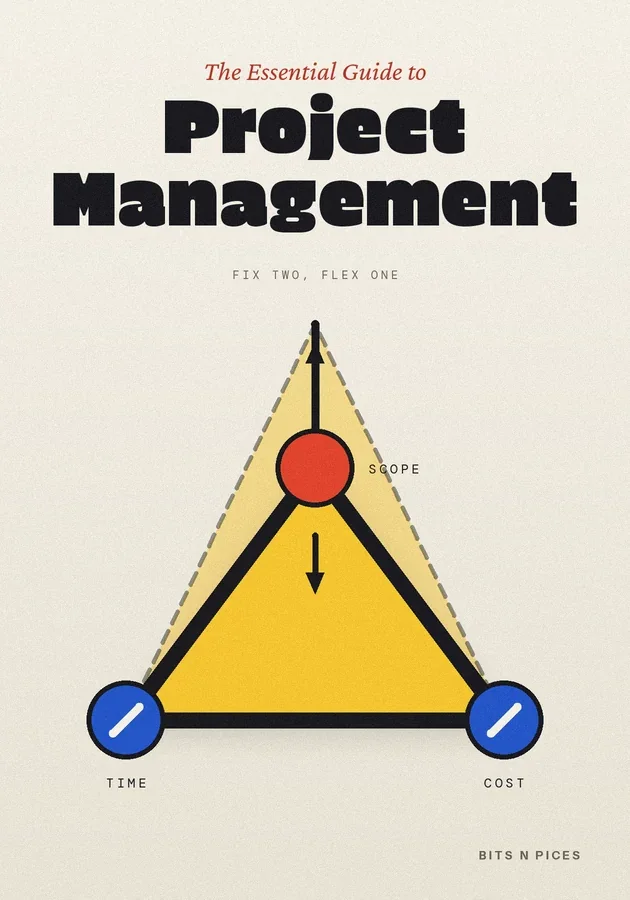
- Trade-offs: fix two, let one flex
Time, cost and scope are linked: change one and at least one other moves. Quality sits in the middle, and it is the one most often cut in silence, because nobody sees the cut until later.
- Time: dependencies, float and hidden slippage
A schedule is a network of tasks linked by dependencies. The longest chain through it is the critical path, and any delay on that chain delays the finish.
- Uncertainty: ranges, risks and the unknown
A single-number estimate hides how much you do not know. A range tells the truth: six to ten weeks says more than eight weeks.
- People: power, interest and the cost of talk
Projects succeed or fail through people, and three ideas carry most of the weight. First, map stakeholders by power and interest.
- Choosing a method, and what to ignore
The sixth idea is method. A plan-first approach defines scope, schedule and budget up front and controls change carefully; it suits work where requirements are stable and late change is costly, such as construction or regulated submissions.
여섯 가지 방법으로 배우기
이 책을 위해 시각화, 마인드맵, 연습, 시나리오, 챌린지, 복습 기능이 준비되어 있어요.
퀴즈와 플래시카드
읽은 내용을 테스트하고 간격 반복으로 확실히 기억하세요.
Bits AI
보고 있는 책, 섹션, 퀴즈 질문에 대해 답변해 줍니다.





