

핵심 요약
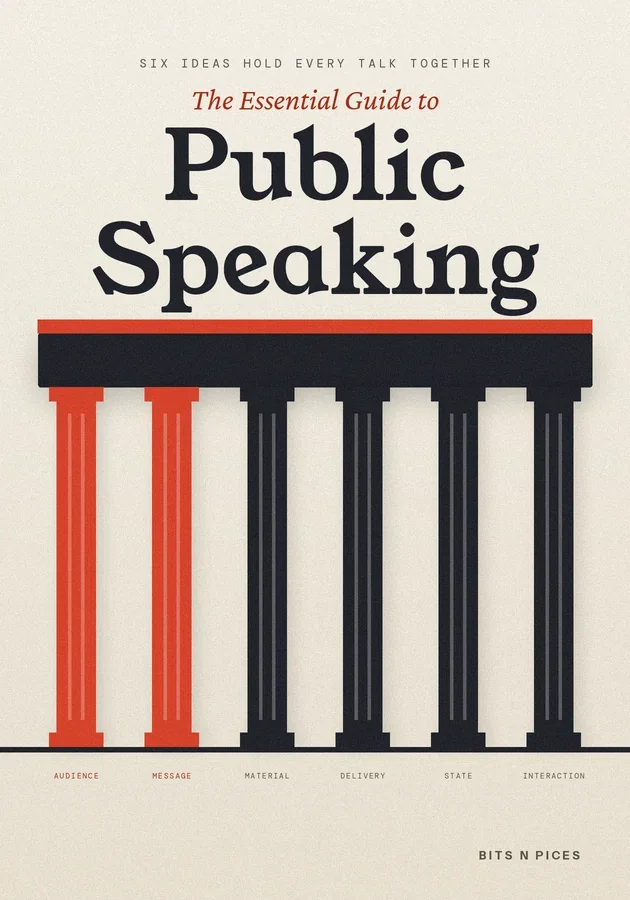
- Every talk rests on six ideas: audience, message, material, delivery, state and interaction; most failures trace back to the first two.
- Start from the question your audience walked in with, answer it in one sentence, and accept that choosing three points means leaving good material out.
- One concrete story or human-scale number makes a point stick better than a pile of facts, as long as it is short and clearly tied to the point.
- Your inner state drives your delivery, so rehearse aloud until the material feels familiar; familiarity calms nerves more reliably than any trick.
- Prioritise a clear message, a prepared opening and close, and rehearsal aloud; ignore rigid gesture rules, memorised scripts and slide effects.
이 비트의 내용
- Six ideas that hold every talk together
Speaking advice arrives as a flood of tips, and nearly all of it belongs to one of six ideas. Audience is who is listening and what they need.
- Audience and message: choosing what to leave out
The most useful question in public speaking is not what do I want to say but what did they come in wanting to know. Listeners arrive with a question, spoken or not, and a talk that answers it feels relevant from the first minute.
- Material that sticks: stories, examples, numbers
Listeners cannot reread a talk, so points must stick the first time. Concrete beats abstract: a named person in a real situation stays with people far longer than a principle.
- Delivery and state: how the talk travels
Delivery is the channel: voice, eyes, stance and slides. At this level the aim is not polish but fit, meaning delivery that sounds like you at your clearest.
- Interaction: questions, pushback and reading the room
A talk is two-way even before the questions start. Faces, posture and phones tell you whether people are with you, and when attention drops you change something: ask a question, move to your example, or say where you are in the talk.
- Where to spend effort, and what to skip
With the map in view, priorities become clear. First, the audience's question and your one-sentence answer, because nothing downstream can rescue a talk aimed at the wrong question.
여섯 가지 방법으로 배우기
이 책을 위해 시각화, 마인드맵, 연습, 시나리오, 챌린지, 복습 기능이 준비되어 있어요.
퀴즈와 플래시카드
읽은 내용을 테스트하고 간격 반복으로 확실히 기억하세요.
Bits AI
보고 있는 책, 섹션, 퀴즈 질문에 대해 답변해 줍니다.





