

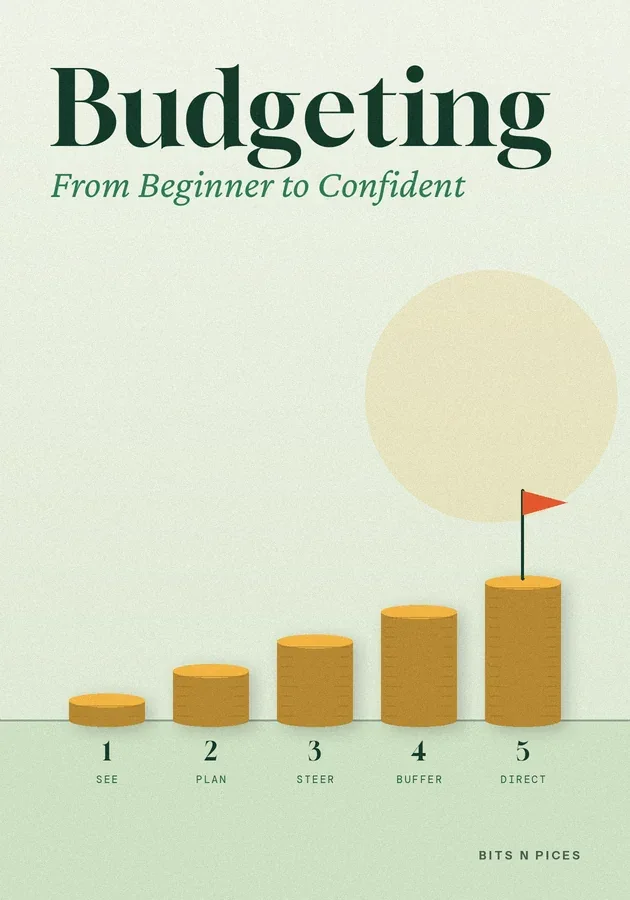
Budgeting: From Beginner to Confident
Belangrijkste inzichten
- Budgeting is a skill that grows in stages: first you see where money goes, then you plan it, steer it, buffer it and finally direct it.
- Track every spend for thirty days without judging it, because an honest picture of last month is the ground every later stage stands on.
- Write the plan before payday and give every rupee of net pay a job, including savings and the bills that arrive only once a year.
- A ten-minute weekly check-in, where you move money between categories instead of abandoning the plan, turns a budget from a wish into a steering wheel.
- You have moved up a rung when a surprise bill no longer becomes a crisis, because a buffer and a sinking fund were already waiting.
In deze bit
- The five rungs from novice to confident
Budgeting is less like a fact you learn once and more like riding a bicycle: a skill that grows in stages. This book uses five rungs.
- Rung one: seeing where the money goes
The first rung has a single task: record every spend for thirty days without trying to change anything. Note the amount, what it was for and how you paid, whether cash, card or a phone payment.
- Rung two: giving every rupee a job
On rung two you stop describing last month and start writing the next one. Take your net pay and assign all of it to categories before the month begins, until the amount left without a job is zero.
- Rung three: steering with a weekly check-in
A plan written on the first of the month is still a guess. Rung three turns it into a steering wheel.
- Rung four: buffers for the bills that surprise you
Most budgets break on bills that were never really surprises: the yearly insurance premium, the phone that needed repairing, the wedding season in winter. Rung four prepares for them in two ways.
- Rung five: directing money and knowing you have arrived
On the top rung your budget stops being about getting through the month and starts pointing somewhere. Name one or two goals with a figure and a date, such as a ₹60,000 course fee by next June, and give each its own line in the plan.
Leer het op zes manieren
Visualiseren, Mindmappen, Oefenen, Scenario, Uitdaging en Herhalen zijn geschreven voor dit boek.
Quiz en flitskaarten
Test wat je hebt gelezen en onthoud het beter met gespreide herhaling.
Bits AI
Het geeft antwoord over het boek, de sectie of de quizvraag waar je mee bezig bent.





