

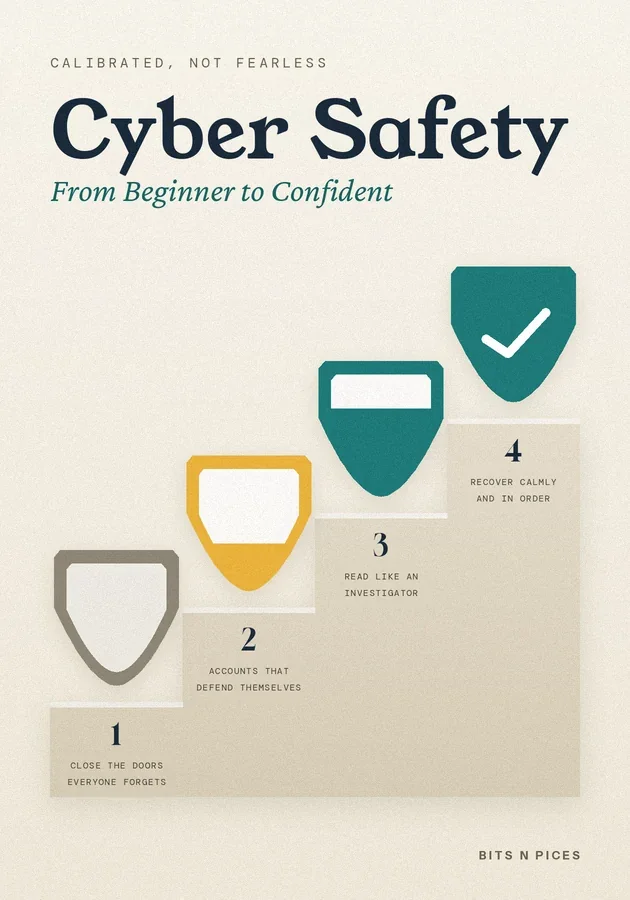
Cyber Safety: From Beginner to Confident
Belangrijkste inzichten
- Confidence in cyber safety means calibrated judgement, not fearlessness: you know which risks matter to you and what you would do first.
- Match the strength of each lock to the stakes: the strongest second steps on email and banking, simpler ones where a loss would be small.
- Move up a rung by making the safe action automatic: a password manager, app-based two-step codes and updates that install themselves.
- Look past the display name, preview every link, and remember that checking a request through the official app almost never costs you anything.
- You have reached confident when you can rehearse recovering an account, a lost phone or a clicked link calmly, and explain the steps to someone else.
In deze bit
- The four rungs from exposed to confident
Most people do not move from careless to careful in one leap. They climb.
- Rung one: close the doors everyone forgets
The first climb is unglamorous, and it removes most everyday risk. Turn on automatic updates for your phone, laptop and browser, because updates patch weaknesses that criminals already know how to use.
- Rung two: accounts that defend themselves
Protected means your defences no longer depend on memory. A password manager is an app that creates, stores and fills a different strong password for every site, behind one master passphrase you learn by heart.
- Rung three: reading messages like an investigator
At this rung the risk shifts from weak locks to being talked into opening them yourself. Phishing is a message designed to make you click, log in, pay or share a code, and spelling mistakes are no longer a reliable sign.
- Rung four: recovering calmly and in order
Confidence shows most clearly when something has already gone wrong, and the order of your actions matters more than their speed. If an account is taken over, secure the email that controls it first, from a device you trust.
- How to prove you have moved up
Feeling safer is not evidence. Test yourself with four checks.
Leer het op zes manieren
Visualiseren, Mindmappen, Oefenen, Scenario, Uitdaging en Herhalen zijn geschreven voor dit boek.
Quiz en flitskaarten
Test wat je hebt gelezen en onthoud het beter met gespreide herhaling.
Bits AI
Het geeft antwoord over het boek, de sectie of de quizvraag waar je mee bezig bent.





