

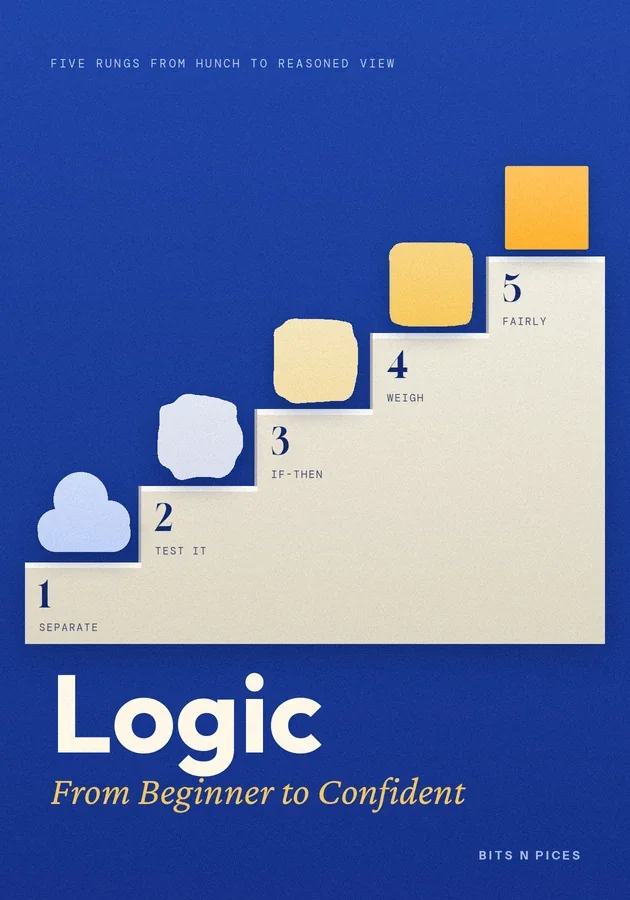
Logic: From Beginner to Confident
Belangrijkste inzichten
- Before judging any argument, find its conclusion and its reasons; a statement with no reason attached is a claim, not yet an argument.
- Ask whether every reason could be true while the conclusion is false; if you can picture that case, the argument does not follow.
- An if-then promise runs one way only: the result appearing does not prove the cause, and a missing cause does not rule out the result.
- Most everyday conclusions are about likelihood, so count the cases behind a claim, check they are typical and name what else could explain them.
- Before you disagree, restate the other person's argument so fairly that they would sign it, then test that strongest version rather than a weak copy.
In deze bit
- Five rungs from hunch to reasoned view
Logic is the study of good reasoning: how reasons support a conclusion, and how to tell when they do not. It is not a talent some people are born with.
- Rung one: separating the point from the reasons
In logic, an argument is not a quarrel. It is a set of reasons offered to support a conclusion.
- Rung two: testing whether it follows
The central test in logic asks one question: if every reason were true, could the conclusion still be false? If you cannot imagine any such case, the argument is valid, meaning the conclusion follows from the premises.
- Rung three: if-then without tripping
If-then sentences, which logicians call conditionals, cause more everyday errors than almost anything else. If the power goes off, the fridge goes quiet promises one thing only: a power cut silences the fridge.
- Rung four: weighing evidence that is not proof
Most real conclusions cannot be proved; they can only be made more or less likely. Reasoning from examples to a general rule is called induction, and its strength rests on two questions.
- Rung five: arguing fairly, and proving you climbed
The top rung turns logic on your own thinking. Before disagreeing, restate the other person's argument in its strongest form, sometimes called steelmanning, until they say yes, that is what I mean.
Leer het op zes manieren
Visualiseren, Mindmappen, Oefenen, Scenario, Uitdaging en Herhalen zijn geschreven voor dit boek.
Quiz en flitskaarten
Test wat je hebt gelezen en onthoud het beter met gespreide herhaling.
Bits AI
Het geeft antwoord over het boek, de sectie of de quizvraag waar je mee bezig bent.





