

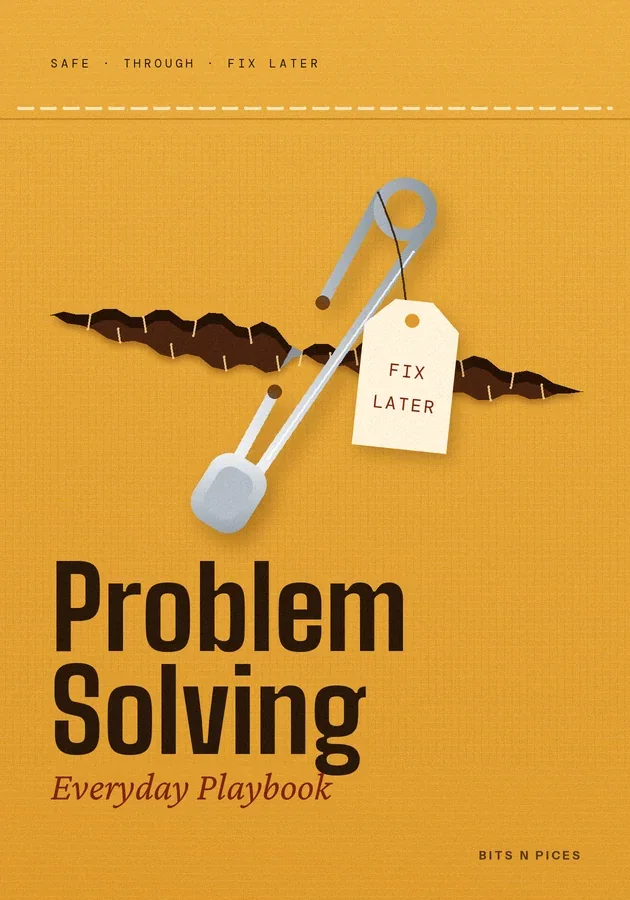
Problem Solving: Everyday Playbook
Belangrijkste inzichten
- When something breaks at a bad moment, make it safe first, get through the next hour second, and leave the proper fix until everyone is calm.
- When a problem happens a second time, mark it on the kitchen calendar, then adjust the routine it is built into rather than nagging anyone.
- In any family clash, ask each person what they need it for and for how long before you decide who gets what.
- When a child says they cannot do something, ask what the easiest bit is, or set five minutes and just begin anywhere.
- When every option looks bad, choose the least-bad one you can undo, and when a fix fails, repair only the point where it broke.
In deze bit
- When something breaks at the worst moment
Breakdowns love bad timing: the car that will not start on the morning of the school trip, the power cut just as dinner goes on. The play has three steps, always in this order.
- When the same problem keeps coming back
Some problems are not emergencies but repeats: the milk that runs out, the key that goes missing, the Monday morning argument. The play is simple.
- When two people want different things
Family clashes usually arrive as demands: I want the television now, I need the laptop tonight. Each demand is a position, meaning what someone says they want.
- When your child says they cannot do it
When a child says I can't do it, they often mean it looks too big to start. The play is to start anywhere.
- When every option looks bad
Some problems offer only unappealing choices, and people freeze. The play has two moves.
- When the fix did not work
Plenty of fixes fail the first time, and the tempting reaction is to scrap the whole plan or blame whoever let it down. The play is more precise: find the break point, the first day or step where the plan stopped working, and ask what was different then.
Leer het op zes manieren
Visualiseren, Mindmappen, Oefenen, Scenario, Uitdaging en Herhalen zijn geschreven voor dit boek.
Quiz en flitskaarten
Test wat je hebt gelezen en onthoud het beter met gespreide herhaling.
Bits AI
Het geeft antwoord over het boek, de sectie of de quizvraag waar je mee bezig bent.





