

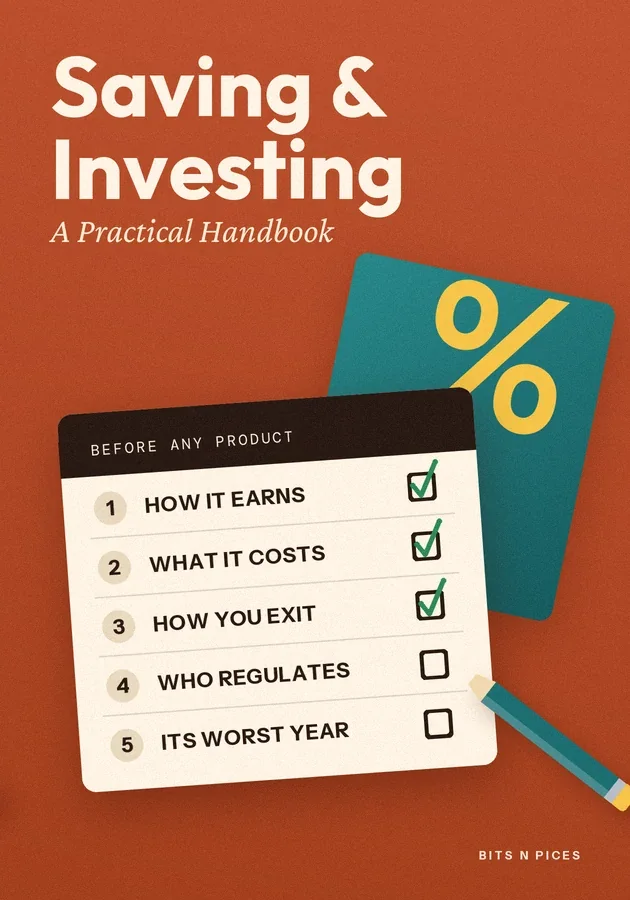
Saving & Investing: A Practical Handbook
Belangrijkste inzichten
- Start with a one-page family money map listing every account, debt and goal with a date, so decisions are made from facts rather than worry.
- Size the emergency fund from essential monthly costs, keep it in a separate easy-access account and fill it with an automatic transfer on payday.
- Turn each goal into a monthly figure by working backwards from the amount and the date, and keep goals under three years in safe savings.
- Before buying any product, ask how it earns, what it costs, how you exit, who regulates the seller and what its worst year looked like.
- Let children watch the family plan work in age-appropriate ways, such as a goal chart, a small savings match or a look at a statement.
In deze bit
- Map the family's money in one evening
Every workable plan starts with an honest picture, and you can draw it in one evening. Take a single sheet and make four boxes.
- Build the emergency fund step by step
An emergency fund is money kept only for genuine shocks: a lost job, a medical bill, an urgent repair. Build it in five steps.
- Turn every goal into a monthly number
A goal without a monthly figure is a wish. Use one sentence as a template: for this goal, by this date, we need this amount, so we set aside this much a month.
- The five-question check before any product
Families are offered financial products everywhere: at bank counters, school events, on the phone and from relatives. Before signing anything, run the same five questions and write down the answers.
- Automate, then review on a calendar
Good intentions fade; standing instructions do not. Set payday transfers in this order: emergency fund until full, then each goal account, then long-term investments, and only then the spending account.
- Bringing the children into the plan
Children learn saving by watching it work, so let them see the parts of the plan that fit their age. For under-sevens, a clear jar with a picture of the goal taped to it makes progress visible.
Leer het op zes manieren
Visualiseren, Mindmappen, Oefenen, Scenario, Uitdaging en Herhalen zijn geschreven voor dit boek.
Quiz en flitskaarten
Test wat je hebt gelezen en onthoud het beter met gespreide herhaling.
Bits AI
Het geeft antwoord over het boek, de sectie of de quizvraag waar je mee bezig bent.





