

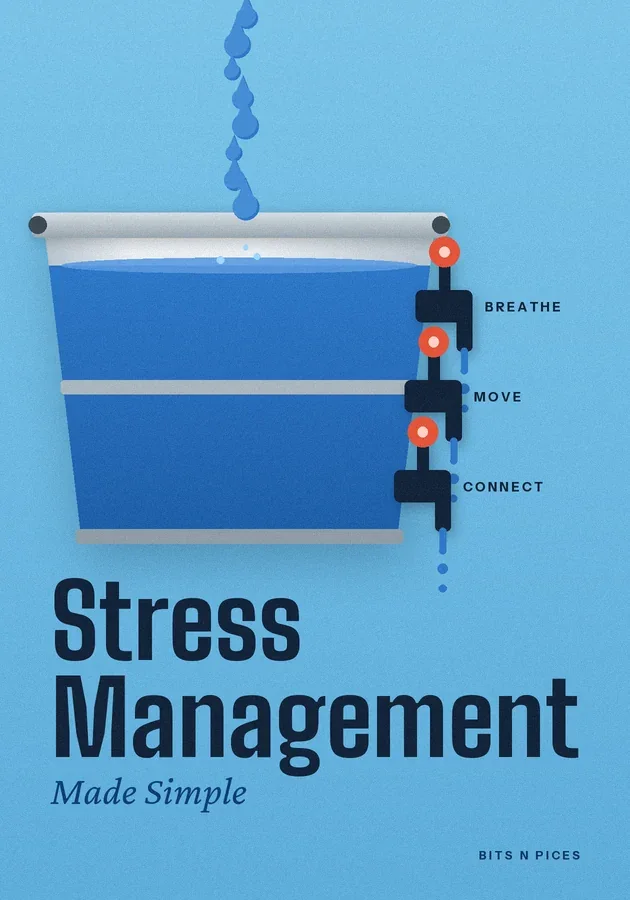
Stress Management Made Simple
Belangrijkste inzichten
- Think of stress as a bucket: worries pour in all day, and small daily habits act as taps that let some out before it overflows.
- Feeling stressed does not make you a bad parent; it makes you a busy person who needs a few simple ways to let the pressure out.
- Three small habits do most of the work: a few slow breaths, a little movement and one proper chat with someone who cares.
- Children learn calm by watching you, so say your feeling and your calming step out loud: 'I feel rushed, so I'm taking three slow breaths.'
- Start one simple family routine at a time, and if stress will not ease for weeks, for you or a child, talk to a doctor, teacher or counsellor.
In deze bit
- Stress in one simple picture
Imagine you carry an invisible bucket. All day, things pour in: the alarm that did not go off, a toddler who will not eat, a message from work, the price of vegetables, a fight in the back seat of the car.
- Five myths that make stress heavier
Some ideas about stress quietly add water to the bucket. Myth one: good parents do not get stressed.
- The three habits that do most of the work
You do not need a long list of techniques. For most busy parents, three small habits give most of the benefit.
- Your children are watching how you cope
Children learn how to deal with stress mostly by watching the adults around them, not by being told. That can sound like pressure, but it is good news, because you do not need perfect calm.
- Small routines that make home calmer
Routines work like handrails on a staircase: they help everyone through busy moments without much thinking. A few simple ones lower the noise in most homes.
- When simple is not enough
Most everyday stress eases when the busy patch passes or when you open the taps a little more. Sometimes it does not, and noticing that is part of looking after your family.
Leer het op zes manieren
Visualiseren, Mindmappen, Oefenen, Scenario, Uitdaging en Herhalen zijn geschreven voor dit boek.
Quiz en flitskaarten
Test wat je hebt gelezen en onthoud het beter met gespreide herhaling.
Bits AI
Het geeft antwoord over het boek, de sectie of de quizvraag waar je mee bezig bent.





