

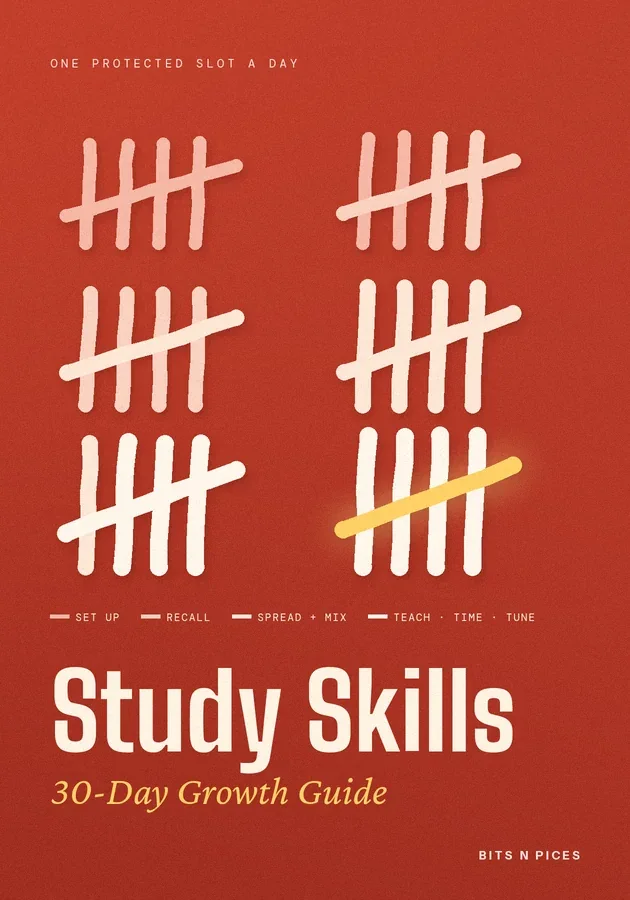
Study Skills: 30-Day Growth Guide
Belangrijkste inzichten
- Start the thirty days with a baseline: write everything you know about your subject and sit a short test, so day twenty-eight has something honest to beat.
- Protect one daily slot of about twenty minutes, tied to something you already do, rather than hoping for long sessions at the weekend.
- Give each week one theme: set up, then recall, then spacing and mixing, then teaching and testing, so every day has a clear micro-action.
- Track three numbers, sessions done, recall score and mock score against baseline, and write one line in your log after every session.
- When a day slips, do the five-minute version; never miss two days running, and if a week slips, resume where you are instead of restarting.
In deze bit
- How the thirty days are built
Thirty days is long enough to change how you study and short enough to stay motivated. The programme has one rule above all others: small and daily beats big and occasional.
- Week one: set up before you speed up
Many plans stall in the first week because people start studying hard before they have made studying easy. Week one is set-up, and each day has one small job.
- Week two: trade rereading for recall
Week two changes what happens inside your twenty minutes. The daily micro-action is simple: before you look at anything, spend the first five minutes writing or saying what you remember from the last session.
- Week three: spread it out and mix it up
By week three you have two weeks of material, and the early topics are quietly fading. This week's micro-action protects them.
- Week four: teach it, time it, tune it
The last week tests whether the learning holds up outside your notes. Two micro-actions carry it.
- Measuring progress and rescuing a slipped week
Track three numbers and nothing else: sessions completed out of thirty, your daily recall score, and your mock score against the baseline. Write one line in a log after every session, such as 'Day 12, 20 minutes, recalled 7 of 10, weak on dates.
Leer het op zes manieren
Visualiseren, Mindmappen, Oefenen, Scenario, Uitdaging en Herhalen zijn geschreven voor dit boek.
Quiz en flitskaarten
Test wat je hebt gelezen en onthoud het beter met gespreide herhaling.
Bits AI
Het geeft antwoord over het boek, de sectie of de quizvraag waar je mee bezig bent.





