

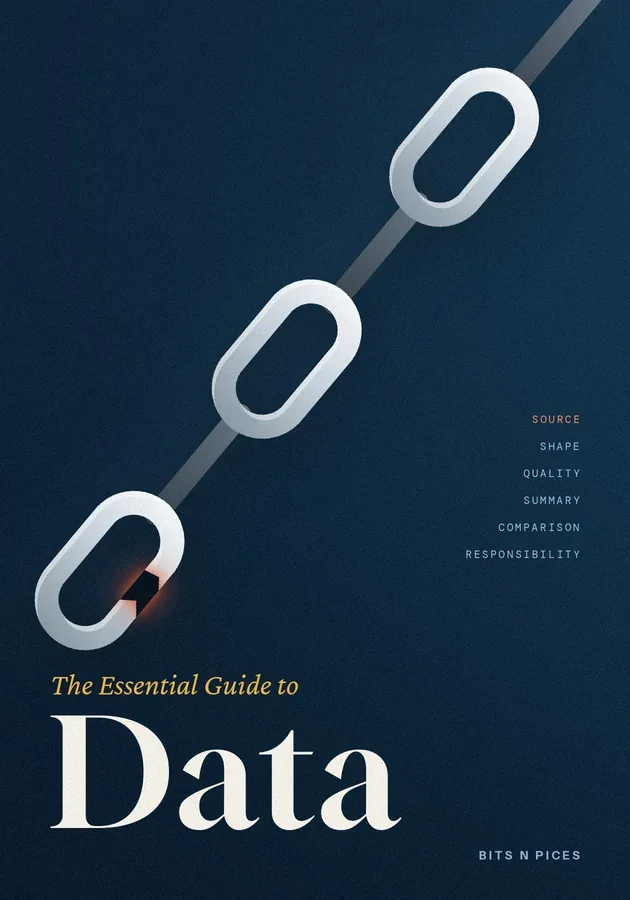
The Essential Guide to Data
Belangrijkste inzichten
- Data work is a chain running from source to shape, quality, summary and comparison, and a weak early link spoils every later one.
- Before trusting any number, ask who collected it, how, when and who was left out, because the collection story sets its limits.
- Clean data only until more cleaning would not change the answer; records fit for the decision beat a perfect dataset that arrives too late.
- Report the centre with the spread and put counts beside percentages, so a rise from four returns to six does not sound like a crisis.
- Every comparison needs a fair baseline and every dataset about people needs care; leave advanced tools until these foundations feel solid.
In deze bit
- Six ideas that hold the whole subject
Data can feel like an endless list of tools and terms, but almost everything in it hangs on six ideas. Source: every number has a collection story.
- Source: every number has a collection story
Before trusting any figure, ask four questions about how it came to exist. Who collected it, and did they have a reason to prefer one answer?
- Shape and quality travel together
Shape and quality are the unglamorous middle of the chain, and they take up most of the effort in real projects. Shape means arranging records as a tidy table, one row per thing and one column per detail, so any tool can count and compare them.
- Summaries: what one number hides
A summary squeezes many values into one, and every squeeze throws something away. The average tells you the centre but not the spread.
- Comparisons: against what, and why
A number on its own says very little. Two hundred units sold could be excellent or disastrous depending on what you compare it with.
- Responsibility, and what to ignore for now
The sixth idea runs through all the others. Data about people deserves care: collect only what you need, tell people what it is for, store it where the wrong people cannot reach it, and delete it when the job is done.
Leer het op zes manieren
Visualiseren, Mindmappen, Oefenen, Scenario, Uitdaging en Herhalen zijn geschreven voor dit boek.
Quiz en flitskaarten
Test wat je hebt gelezen en onthoud het beter met gespreide herhaling.
Bits AI
Het geeft antwoord over het boek, de sectie of de quizvraag waar je mee bezig bent.





