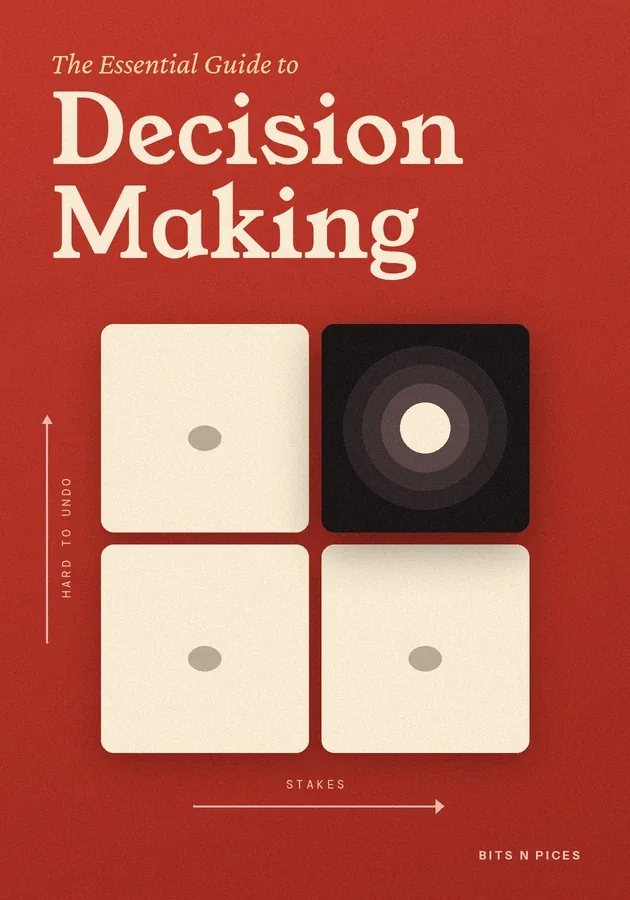
The Essential Guide to Decision Making
Belangrijkste inzichten
- Before weighing any options, size the decision by its stakes and how hard it is to undo, and spend your effort where both are high.
- Judge a decision by the information, options and reasoning you had at the time, never by the result alone, because luck writes part of every outcome.
- When a choice arrives as yes or no, rewrite it as a question about the goal underneath and find at least three real options.
- Start every forecast from how similar cases usually turn out, give it as a range, and refuse bets that could ruin you however good the average.
- Protect big decisions with process rather than willpower: write your own estimate before hearing others, ask someone to argue the other side, and run a pre-mortem.
In deze bit
- Sizing a decision before you make it
Most bad decision habits start with a mismatch: agonising for a week over a choice you could easily reverse, then signing a sticky one in an afternoon. So the first big idea is triage.
- Separating decision quality from luck
Every outcome is a blend of two things: how well the decision was made and the luck that followed. You control only the first.
- Framing the question behind the question
The way a choice is worded decides which answers you can see. Yes-or-no framings are the usual trap: should I take this job, should we buy this flat, should I drop this client.
- Thinking in odds, ranges and base rates
Every decision is a bet on the future, so the quality of your estimates matters. Three habits improve them.
- Designing around bias, alone and in groups
Knowing the names of biases does surprisingly little, because people spot them in others and miss them in themselves. What works is building the correction into the process.
- Values, stopping rules and what to ignore
The last idea ties the map together. Criteria come from values, meaning what you are trying to protect or build.
Leer het op zes manieren
Visualiseren, Mindmappen, Oefenen, Scenario, Uitdaging en Herhalen zijn geschreven voor dit boek.
Quiz en flitskaarten
Test wat je hebt gelezen en onthoud het beter met gespreide herhaling.
Bits AI
Het geeft antwoord over het boek, de sectie of de quizvraag waar je mee bezig bent.