

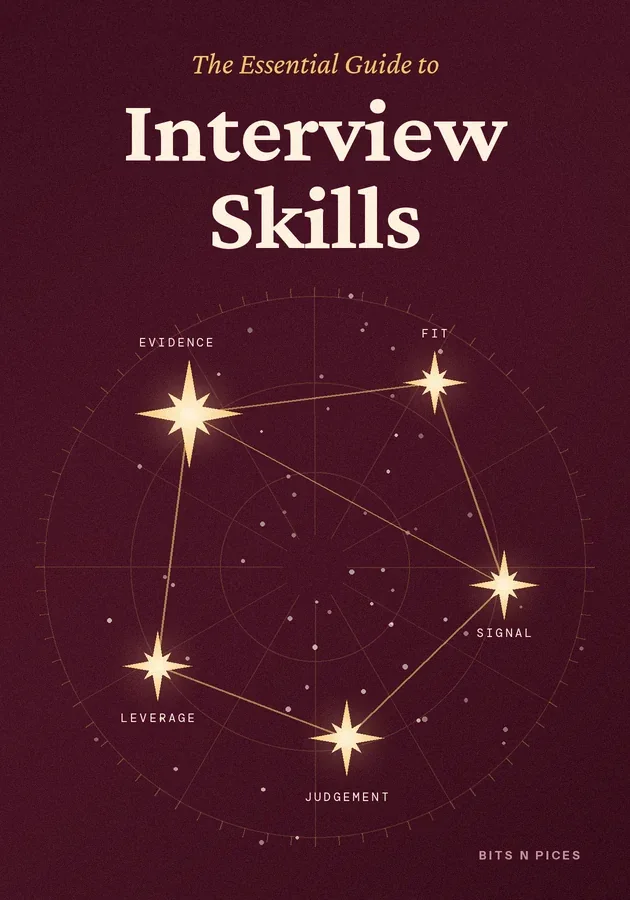
The Essential Guide to Interview Skills
Belangrijkste inzichten
- Five ideas explain every interview: evidence, fit, signal, judgement and leverage, and knowing which one a question serves tells you how to answer it.
- Interviewers form an impression in the first minutes and then look for confirmation, so open with your strongest evidence rather than saving it.
- Fit runs both ways, and the questions you ask about how decisions are made and what failure looks like reveal more than any careers page.
- Prioritise clarity, brevity and concrete detail, and stop worrying about perfect posture, memorised lines and the one question you fumbled.
- An offer is where leverage peaks and then decays, so decide what you need before it arrives and negotiate once, calmly, in writing.
In deze bit
- The map: five ideas that organise everything
Interview advice arrives as hundreds of tips, and most of it fits inside five ideas. Evidence is the proof that you can do the job.
- Evidence: how interviewers actually decide
Most interviewers decide faster than they admit. In an unstructured interview, an impression forms in the opening minutes and the rest of the hour is spent gathering support for it.
- Fit: the interview you are conducting
Fit is the idea most candidates neglect because it feels like a luxury. It is not.
- Signal: what to prioritise and what to ignore
Signal is the packaging of evidence, and it has three parts worth effort and many that are not. Prioritise clarity: one idea per answer, stated first.
- Judgement: the questions built to unsettle you
Once evidence, fit and signal are established, advanced interviews test judgement with questions that have no clean answer. Hypotheticals ask what you would do if a client demanded something unethical.
- Leverage: from offer to decision
Leverage begins when the offer arrives and starts to fade the moment you accept. Before any offer, write down your walk-away figure, the two non-salary terms that matter most, such as start date or remote days, and what would make you decline regardless.
Leer het op zes manieren
Visualiseren, Mindmappen, Oefenen, Scenario, Uitdaging en Herhalen zijn geschreven voor dit boek.
Quiz en flitskaarten
Test wat je hebt gelezen en onthoud het beter met gespreide herhaling.
Bits AI
Het geeft antwoord over het boek, de sectie of de quizvraag waar je mee bezig bent.





