

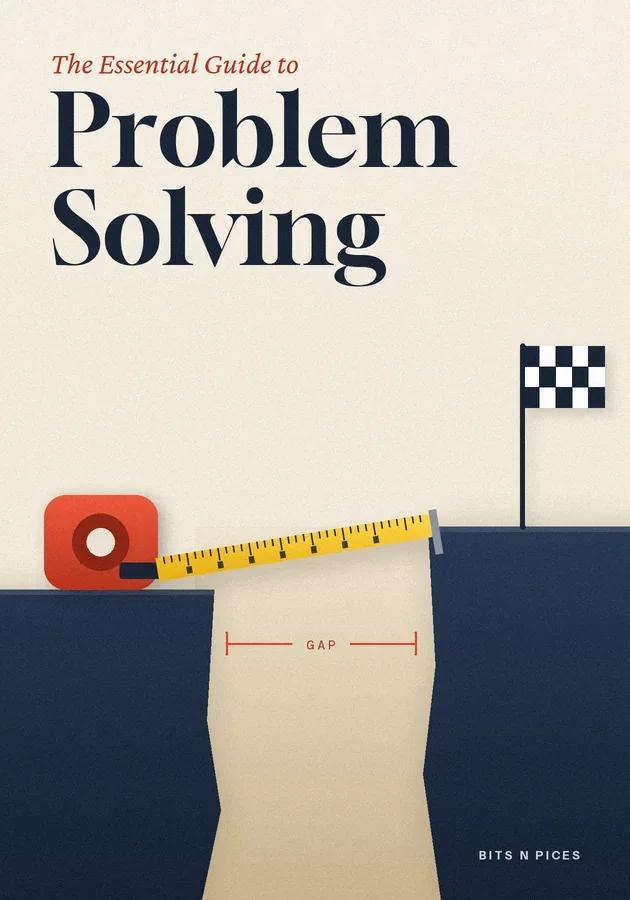
The Essential Guide to Problem Solving
Belangrijkste inzichten
- Write the problem as a gap with a finish line and its constraints, and ask what any request is really for before touching a solution.
- When something breaks, trace the process stage by stage to find where the trouble starts, then ask why until you reach a cause you can act on.
- When nothing is broken, list options before judging any, include a cheap partial version, choose on two or three criteria, and name the trade-off.
- Measure a baseline before any change and, where you can, leave a similar place untouched, so you can tell your fix from luck.
- Balance speed against certainty and effort against stakes, and ignore many-boxed frameworks and the hunt for one right answer.
In deze bit
- A problem is a gap, not a feeling
In problem solving, a problem is a gap between what is happening and what should be happening. The goal is where you want to end up.
- Define the gap before chasing answers
Defining a problem means writing it down precisely enough that two people would agree whether it has been solved. A useful definition has four parts: what is happening, how often or how much, what solved would look like, and the constraints any solution must respect.
- Causes before cures when something breaks
When something that used to work stops working, look for the cause before the cure. A symptom is what you notice; a cause is what produces it; the root cause is the deepest cause you can act on.
- Options before choices when nothing is broken
When nothing is broken but you want better, there is no single cause to find, so the work starts with options. Keep two kinds of thinking apart.
- Evidence before confidence
Confidence is not evidence. However good the reasoning, a fix is a guess until it meets real life, so measure the gap before you change anything.
- The trade-offs that hold the map together
The ideas on this map pull against each other, and three trade-offs decide how to use them. Speed against certainty: more investigation gives surer answers but delays the fix.
Leer het op zes manieren
Visualiseren, Mindmappen, Oefenen, Scenario, Uitdaging en Herhalen zijn geschreven voor dit boek.
Quiz en flitskaarten
Test wat je hebt gelezen en onthoud het beter met gespreide herhaling.
Bits AI
Het geeft antwoord over het boek, de sectie of de quizvraag waar je mee bezig bent.





