

The Essential Guide to Sleep
Belangrijkste inzichten
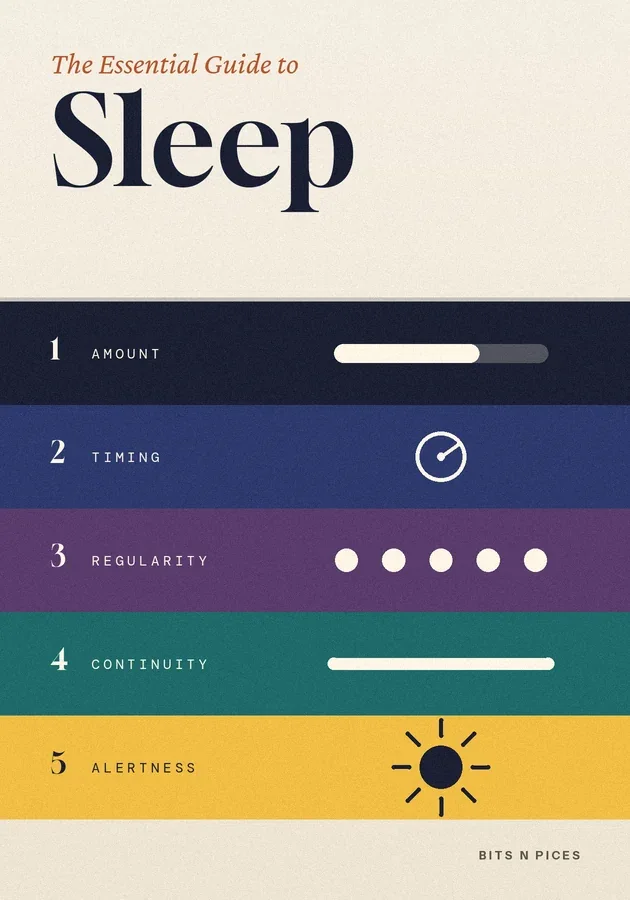
- Every night has five parts, amount, timing, regularity, continuity and next-day alertness, and fixing the weakest one helps more than adding hours.
- Judge whether you sleep enough by how alert you feel through the day without caffeine props, not by hitting an exact number of hours.
- Keep your sleep at similar times all week, because the body clock expects sleep on a schedule and irregular nights leave you out of step.
- Your day builds your night: morning light, earlier exercise, an afternoon caffeine cut-off and an evening worry list all make sleep come easier.
- Prioritise a steady wake time and a dark, quiet room, ignore perfect scores and gadgets, and take warning signs to a doctor.
In deze bit
- Five things that make a night
Most people judge sleep by a single number: hours. The complete picture has five parts.
- Amount: finding enough, not the most
Most adults need roughly seven to nine hours of sleep, but your own figure is personal, and the best test is the day rather than the clock. If you wake without much struggle, stay alert through the late morning without a string of coffees, and do not nod off when you sit still in the afternoon, you are probably getting enough.
- Timing and regularity: the clock side
Your body clock expects sleep at roughly the same time every day, and it runs your temperature, hormones and alertness to that schedule. Timing asks whether your sleep sits where your clock wants it; regularity asks whether it sits there consistently.
- Continuity: keeping the night in one piece
Seven hours broken into many pieces feels worse than a slightly shorter night in one block. Short wakings between sleep cycles are normal and usually forgotten.
- The daytime half of sleep
Sleep is prepared long before bedtime. Morning daylight sets the clock so that evening sleepiness arrives on time.
- What to prioritise and what to ignore
Energy for change is limited, so spend it where the return is highest. Prioritise a steady wake time, enough time in bed for your own need, a dark and quiet room, and caffeine finished by early afternoon.
Leer het op zes manieren
Visualiseren, Mindmappen, Oefenen, Scenario, Uitdaging en Herhalen zijn geschreven voor dit boek.
Quiz en flitskaarten
Test wat je hebt gelezen en onthoud het beter met gespreide herhaling.
Bits AI
Het geeft antwoord over het boek, de sectie of de quizvraag waar je mee bezig bent.





