

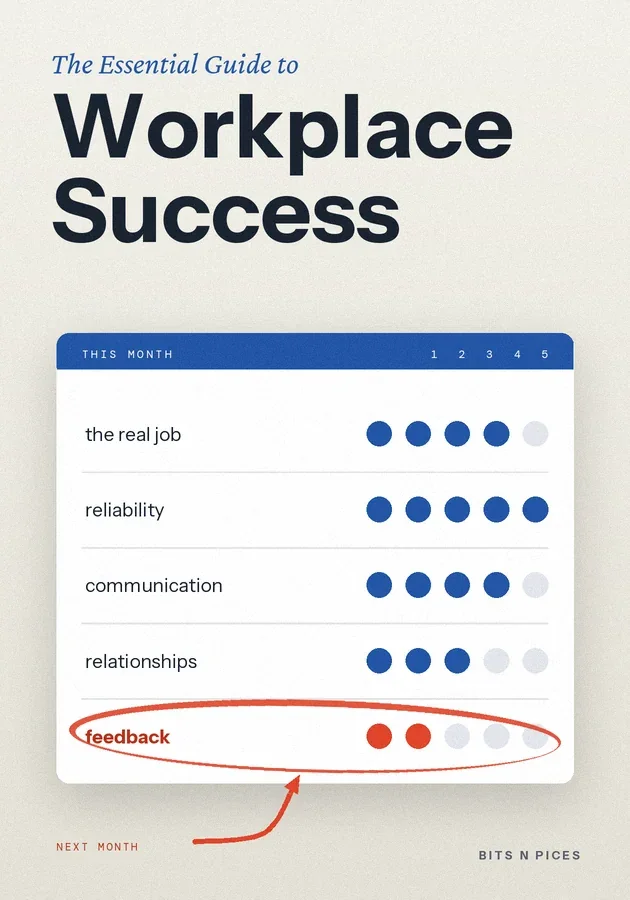
The Essential Guide to Workplace Success
Belangrijkste inzichten
- Ask your manager what a good month looks like in your role, because the real job is rarely the same as the job description.
- Treat every date as a promise: check your workload before you name it, and if it must move, renegotiate before it passes, never after.
- Write messages that stand alone: the request, the deadline and where everything is, readable on a phone without scrolling back.
- Treat feedback as information rather than a verdict: say thank you, ask one clarifying question, and decide within a day what you will change.
- Once a month, score yourself from one to five on each of the five ideas and put next month's effort into the weakest.
In deze bit
- What success at work really means
Success at work is not the same as being busy, and it is not the same as being liked. A more useful definition is this: over time, people trust you with more important work, and you can keep up the pace without wearing yourself out.
- Reliability is the foundation
If you keep only one idea from this map, keep reliability: doing what you said you would do, by when you said you would do it. Everything else at work rests on it.
- Communication that makes your work easy to use
Most of your work reaches other people as messages: emails, chat notes and quick words in meetings. Good workplace communication is not about impressive words.
- Working relationships multiply your effort
Nobody succeeds at work alone. Your results depend on three groups: your manager; your peers, the colleagues on your own team; and stakeholders, the people in other teams who are affected by your work or can help it.
- Feedback and growth: getting better on purpose
Feedback is information about how your work lands with other people. Positive feedback tells you what to keep doing; developmental feedback tells you what to change.
- How the ideas fit, and what to ignore
The five ideas stack in a definite order. Knowing the real job tells you where to aim.
Leer het op zes manieren
Visualiseren, Mindmappen, Oefenen, Scenario, Uitdaging en Herhalen zijn geschreven voor dit boek.
Quiz en flitskaarten
Test wat je hebt gelezen en onthoud het beter met gespreide herhaling.
Bits AI
Het geeft antwoord over het boek, de sectie of de quizvraag waar je mee bezig bent.





