

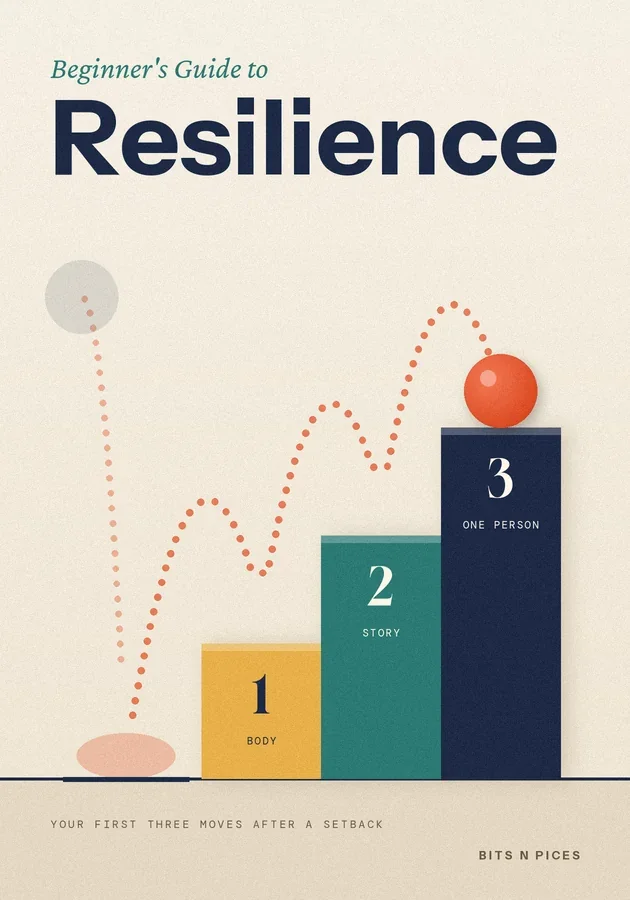
Beginner's Guide to Resilience
Principais ideias
- Resilience is the ability to adapt and recover after difficulty, not a talent for never struggling or for hiding how you feel.
- After a setback, steady your body first with food, water, a short walk and your usual bedtime, because a tired body makes every problem look bigger.
- Check the story you tell yourself: a setback is usually temporary, limited to one area of life and not proof that you are a failure.
- Tell one trusted person what happened within a day or two, because support from others is one of the strongest cushions against hard times.
- Keep a short record of setbacks you came through and what helped, and read it when the next one arrives to remind yourself you recover.
Dentro deste bit
- What resilience means, and what it doesn't
Resilience is the ability to adapt to difficulty and recover your footing afterwards. It shows up after a failed exam, a lost job, a break-up, an illness in the family or a business that has a terrible month.
- Why it is ordinary and learnable
Everyone meets setbacks, so resilience is not a special skill for people in crisis. It decides how long a disappointment keeps you from sleeping well, working well and being good company.
- The vocabulary of bouncing back
A few terms help you think clearly about hard times. A stressor is anything that puts pressure on you, from a deadline to a death in the family.
- Your first three moves after a setback
When something goes wrong, three moves, in this order, help most beginners. First, steady the body.
- Classic beginner mistakes
Five mistakes trip up most people who are new to building resilience. The first is pretending to be fine, which delays recovery because feelings that are pushed down tend to leak out somewhere else.
- Growing resilience over time, within its limits
Resilience grows through small, repeated practices rather than one big effort. Keep an evidence file: a note on your phone or in a notebook listing difficulties you came through and what helped each time.
Aprende de seis maneiras
Visualizar, Mapa Mental, Praticar, Cenário, Desafio e Revisão foram criados para este livro.
Quiz e flashcards
Testa o que leste e guarda-o com repetição espaçada.
Bits AI
Responde sobre o livro, a secção e a pergunta do quiz em que estás.





