

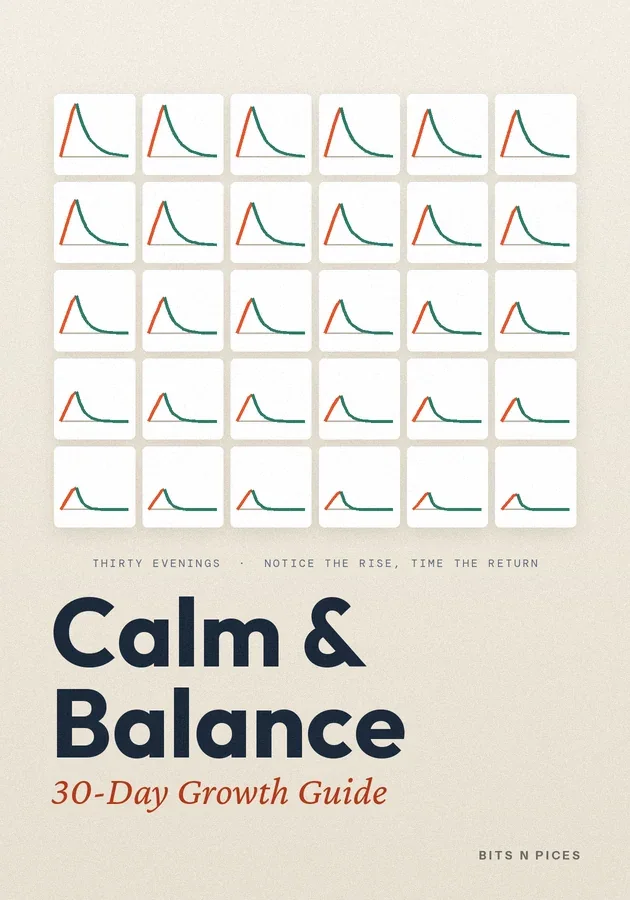
Calm & Balance: 30-Day Growth Guide
Principais ideias
- Calm is not the absence of stress but the ability to notice pressure early and return to steady, and that ability grows with daily practice.
- A two-line evening check-in, rating your tension and naming the moment it rose most, gives you the evidence to see progress you would otherwise miss.
- Practise steadying techniques such as a longer out-breath while you are already calm, so they are ready when a hard moment arrives.
- When a week slips, shrink each daily action to its smallest form and repeat the week, rather than trying to catch up or quitting.
- Progress means recovering faster and asking for support sooner, and distress that lasts for weeks is a reason to see a doctor or counsellor.
Dentro deste bit
- How the thirty days fit together
Calm and balance are easy to misunderstand. Calm does not mean feeling nothing or never getting annoyed.
- Week one: learning your early warning signs
Stress usually announces itself before it takes over. The signals are personal: a tight jaw, a racing mind at bedtime, snapping at small things, reaching for your phone every few minutes or a sudden urge to cancel plans.
- Week two: three ways to steady yourself
Week two gives you three techniques and asks you to practise each while you are already fairly calm. That sounds backwards, but a skill rehearsed on an easy day is far more available on a hard one, just as fire drills happen when there is no fire.
- Week three: routines that protect your balance
Techniques help in the moment; routines stop some of those moments from building up in the first place. Week three looks at the edges of your day, where stress tends to leak in: how you start, how you switch between roles and how you wind down.
- Week four: talking, asking and sharing the load
Balance is rarely a solo project. Week four turns outward, because other people can be one of the steadiest supports you have and also one of the biggest sources of strain.
- Measuring progress and restarting a slipped week
On day thirty, read back your check-ins from the first week and the last. Progress rarely looks like a line of perfect scores.
Aprende de seis maneiras
Visualizar, Mapa Mental, Praticar, Cenário, Desafio e Revisão foram criados para este livro.
Quiz e flashcards
Testa o que leste e guarda-o com repetição espaçada.
Bits AI
Responde sobre o livro, a secção e a pergunta do quiz em que estás.





