

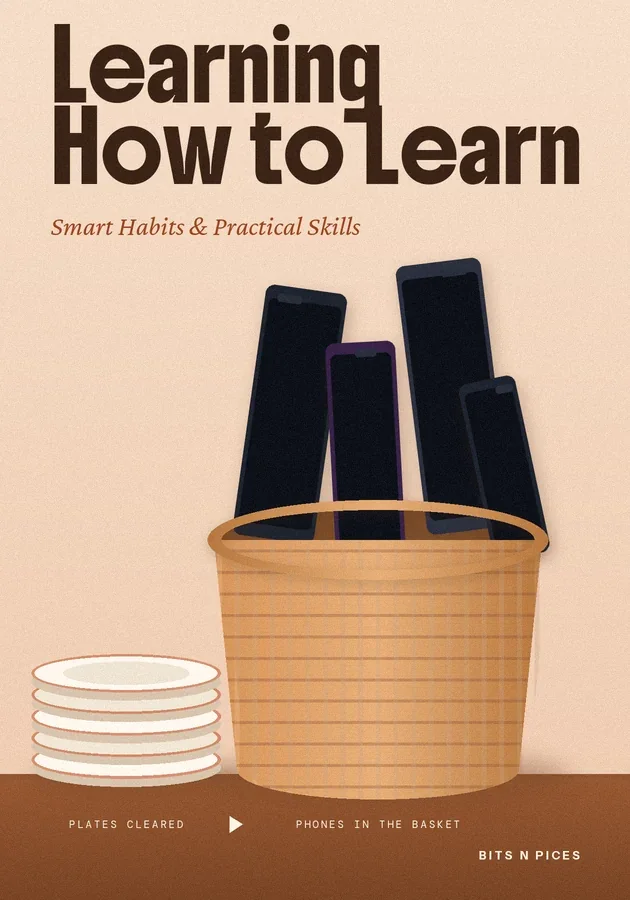
Learning How to Learn: Smart Habits & Practical Skills
Principais ideias
- Run learning on a small daily system and do some learning yourself at the same table, because children copy the routine they see.
- Anchor the session to an event that happens every day, such as clearing the dinner plates, because clock times break on irregular schedules.
- Make starting effortless and drifting awkward, and put your own phone in the basket too, since children follow the rules adults visibly keep.
- Log mistakes fixed rather than hours studied, and praise the strategy your child used rather than their talent, so attention stays on the process.
- Agree a floor version and a restart ritual before busy seasons, and hand teenagers the design of their own system while you act as consultant.
Dentro deste bit
- Systems that outlast motivation
Most family learning runs on bursts: a determined Sunday, a panicked night before an exam, a resolution after a bad report. Bursts tend to produce results that fade within weeks.
- Cues that start the session without nagging
A cue is whatever tells the brain it is time to begin. Most families use the weakest cue available, a parent's voice, which turns every session into a negotiation.
- Friction: make starting easy and drifting hard
Friction is the small effort that stands between you and an action. Good habit design lowers it for learning and raises it for distraction.
- Tracking and rewards that keep attention on learning
What you track shapes what your family does, so choose carefully. Tracking hours invites padding: a child can sit for forty minutes and learn little.
- Conversations that teach children how learning works
The words you use at home teach children what learning is. Praise that names a talent, 'you are so clever', tells them success is fixed, so a hard problem becomes a threat.
- Keeping it going through busy seasons
Family routines rarely fail on an ordinary Tuesday. They fail in exam weeks, festival holidays, a house move or the arrival of a baby, and they tend to decay quietly, then all at once.
Aprende de seis maneiras
Visualizar, Mapa Mental, Praticar, Cenário, Desafio e Revisão foram criados para este livro.
Quiz e flashcards
Testa o que leste e guarda-o com repetição espaçada.
Bits AI
Responde sobre o livro, a secção e a pergunta do quiz em que estás.





