

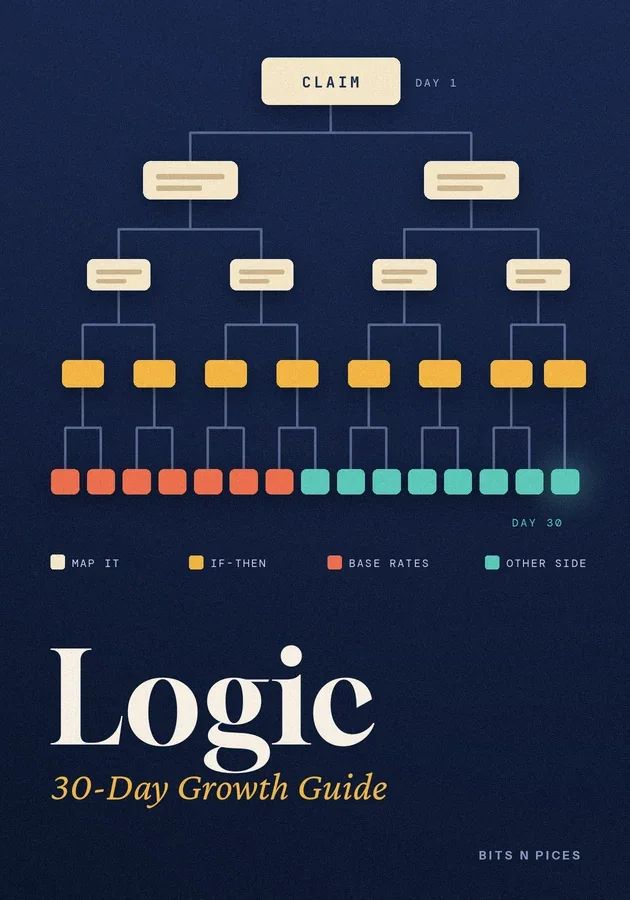
Logic: 30-Day Growth Guide
Principais ideias
- Map one real argument before day one and again on day twenty-nine, because a month of practice only counts if you can show what changed.
- Arguments that sound complete usually lean on a premise nobody states, so write the missing one down and ask whether you would accept it alone.
- From if A then B, only the contrapositive follows, if not B then not A; the converse and the inverse are separate claims needing their own evidence.
- Turn percentages into counts of cases before trusting any test or alert, because when the thing checked is rare, most alarms can be false.
- A bad argument does not make its conclusion false, so rate your confidence in claims and keep score until being wrong becomes useful information.
Dentro deste bit
- How the month runs and where you start
This programme gives logic four weeks with one theme each: the structure of arguments, the traps in if-then and all-or-some statements, reasoning under uncertainty, and reasoning against your own preferences. Each day brings one micro-action of ten to fifteen minutes, done on material you meet anyway: a work email, a news report, a family decision.
- Week one: mapping and the premise nobody says
Week one trains structure. An argument map lays reasoning out on paper: the conclusion at the top, each premise numbered beneath it, and arrows showing which premises work together.
- Week two: conditionals, quantifiers and shifting words
Week two drills the moves that trip careful readers. From if A then B come three look-alikes: the converse, if B then A; the inverse, if not A then not B; and the contrapositive, if not B then not A.
- Week three: base rates, luck and hidden causes
Week three is the hardest and the most useful. Its central skill is respecting the base rate, how common something is before any evidence arrives.
- Week four: arguing against your own side
The last week points every tool at you. Motivated reasoning is the pull to accept weak arguments for conclusions you like while demanding proof for ones you do not.
- Scoring the month and rescuing a slipped week
Three measures tell you whether the month worked. The first is the baseline rerun on day twenty-nine: the same argument, mapped again from scratch and compared with your first map.
Aprende de seis maneiras
Visualizar, Mapa Mental, Praticar, Cenário, Desafio e Revisão foram criados para este livro.
Quiz e flashcards
Testa o que leste e guarda-o com repetição espaçada.
Bits AI
Responde sobre o livro, a secção e a pergunta do quiz em que estás.





